
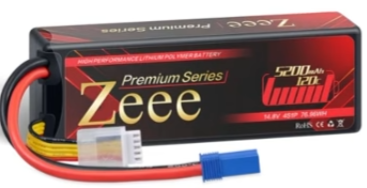
The Zeee Premium vs CNHL comparison explores an interesting question: can two budget Zeee Premium packs connected in parallel outperform a single CNHL 90C battery? Both setups offer similar total capacity on paper, but real-world performance often tells a different story.
For this test, I compared two Zeee Premium 4S 5200mAh 120C hard-case batteries wired in parallel against a single CNHL 4S 5200mAh 90C soft-case battery. The goal was to measure power output, voltage retention, and usable capacity during a continuous 105A load test.
Test Setup
The Zeee setup consisted of two 5200mAh packs connected in parallel for a combined capacity of 10,400mAh. The CNHL remained a single 5200mAh pack.
Price was another factor in this comparison. At the time of testing, two Zeee Premium packs cost approximately $54 USD, while the CNHL 90C was available for about $40 USD on sale.
Internal Resistance Results
Internal resistance often provides a good indication of how well a battery will perform under heavy load.
The CNHL averaged 1.54mΩ per cell, while the pair of Zeee Premium batteries averaged 3.43mΩ per cell when measured as a parallel set.
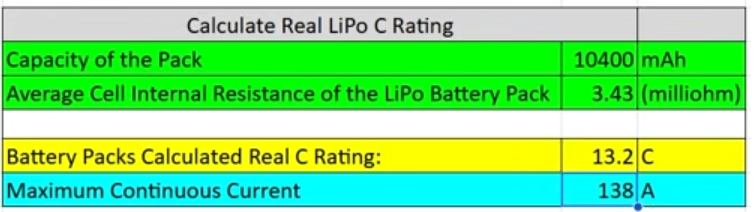
Using the RC LiPo Calculator:
| Battery | Capacity | Avg IR | Calculated C Rating | Continuous Current |
|---|---|---|---|---|
| CNHL 90C | 5200mAh | 1.54mΩ | 27.9C | 145A |
| 2x Zeee Premium | 10,400mAh | 3.43mΩ | 13.2C | 138A |
Despite having double the capacity, the Zeee setup calculated slightly lower continuous current capability than the single CNHL pack.
105A Load Test Results
The real story emerged during the 105A load test.
| Metric | CNHL 90C | 2x Zeee Premium | Advantage |
|---|---|---|---|
| Maximum Wattage | 1753W | 1644W | CNHL +6.6% |
| Wattage at 10 Seconds | 1625W | 1531W | CNHL +6.1% |
| Wattage at 30 Seconds | 1543W | 1467W | CNHL +5.2% |
| Wattage at 60 Seconds | 1491W | 1454W | CNHL +2.5% |
| Wattage at 90 Seconds | 1403W | 1446W | Zeee +3.1% |
| Wattage at Cutoff | 1261W | 1161W | CNHL +8.6% |
| Delivered Capacity | 4697mAh | 7758mAh | Zeee +65% |
| Voltage at 10 Seconds | 3.65V | 3.54V | CNHL +3.1% |

Power Performance
The CNHL dominated the early stages of the test. At maximum current, it produced 1,753W compared to 1,644W from the Zeee setup. The advantage continued at both the 10-second and 30-second marks. Even after 60 seconds, the CNHL still maintained a power advantage.
The first time the Zeee setup moved ahead was at the 90-second mark. By that point, the larger capacity reserve allowed it to maintain slightly higher wattage. However, that advantage arrived much later in the discharge cycle.
Runtime and Capacity
The biggest strength of the parallel Zeee setup was runtime. The two packs delivered 7,914mAh under load, compared with 4,806mAh from the CNHL. That represents roughly 65% more usable capacity.
Still, the increase was smaller than many people might expect. While the Zeee setup had double the rated capacity, it did not deliver double the usable capacity during the test. Voltage sag limited how much of that extra capacity could be used effectively.
Final Thoughts
This test produced a surprising result. Despite having only half the capacity, the CNHL delivered more power for the first 60 seconds of the run. It also maintained higher voltage throughout the early and middle portions of the test.
The Zeee setup fought back with a clear runtime advantage. If longer run times are your goal and you have room for two packs, the parallel configuration makes sense.
However, if your priority is maximum power and performance, the CNHL remains the better choice. One CNHL 90C battery outperformed two Zeee Premium packs in parallel during the most demanding portion of the test.
Want the full data behind these battery tests? Join the RCexplained Battery Benchmark Squadron for access to detailed benchmark spreadsheets, internal resistance data, ranked battery comparisons, historical test data, plus the monthly RC Calculator spreadsheet and advanced data log analysis tools for Castle Creations ESCs used throughout this site. See membership options here.