
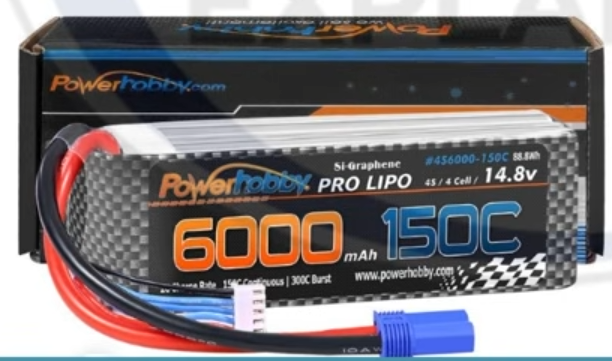
The Powerhobby vs CNHL load test compares two 6000mAh 4S LiPo packs under the same 105A discharge test. On paper, the Powerhobby carries a much higher 150C rating. However, real-world testing tells a very different story.
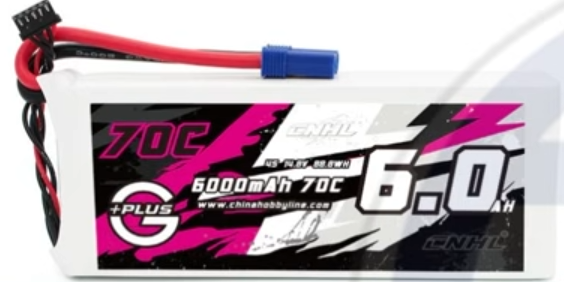
The Powerhobby 6000mAh 150C uses a soft case and EC5 connector. It sells for about $139.95 USD. The CNHL G+ 6000mAh 70C also uses a soft case and EC5 connector but costs only $45.99 USD. Despite the lower advertised C rating, the CNHL entered this test with a major price advantage.
Internal Resistance Results
Internal resistance measurements showed a large gap between the two batteries.
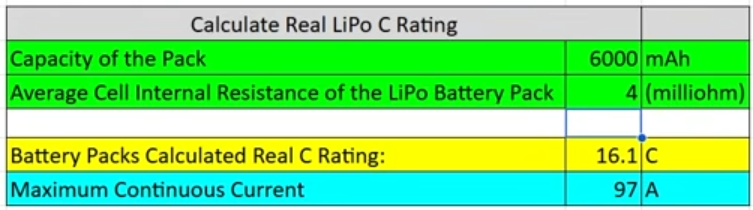
The Powerhobby averaged 4.0 mΩ per cell. Using the RC LiPo calculator, that translates to a real-world C rating of about 16.1C and a calculated continuous current capability of 97A.
The CNHL G+ previously tested at a much lower resistance value. As a result, it was expected to perform better under heavy load despite its lower advertised 70C rating.
Load Test Results
Both batteries were tested at approximately 105A.
The Powerhobby completed the test but spent much of the run near 100A. Near the end of the discharge, it reached both thermal and voltage limits.

The CNHL maintained stronger voltage throughout the test and delivered significantly more usable capacity.
Performance Results
| Metric | Powerhobby 6000mAh 150C | CNHL G+ 6000mAh 70C |
|---|---|---|
| Total Capacity (mAh) | 3,532 | 5,312 |
| Energy Per Cell (Wh) | 718 | 1,113 |
| Average Cell Wattage (W) | 318 | 354 |
| Voltage at 10 Seconds (V) | 3.47 | 3.71 |
| mAh to 3.5V | 266 | 1,850 |
| Time to 3.5V (s) | 10.0 | 63.0 |
| mAh to 3.6V | 52 | 852 |
| Time to 3.6V (s) | 2.1 | 28.6 |
Voltage Performance
Voltage retention was one of the biggest differences in this Powerhobby vs CNHL load test.
After only 10 seconds, the Powerhobby had already dropped to 3.47V per cell. Meanwhile, the CNHL remained at 3.71V per cell.
The CNHL also stayed above both 3.6V and 3.5V far longer. Consequently, it delivered much more usable capacity before significant voltage sag occurred.
Final Thoughts
The results were not close. The CNHL G+ outperformed the Powerhobby in every major category. It delivered more usable capacity, more energy, higher average wattage, and stronger voltage retention throughout the discharge.
More importantly, it achieved those results while costing roughly one-third as much as the Powerhobby. The Powerhobby can still be used in lower-demand RC vehicles where current draw remains modest. However, for high-power applications, larger vehicles, or drivers seeking maximum performance, the CNHL G+ is the clear choice.
Based on this Powerhobby vs CNHL load test, the CNHL G+ 6000mAh 70C offers substantially better value and significantly stronger real-world performance.
Want the full data behind these battery tests? Join the RCexplained Battery Benchmark Squadron for access to detailed benchmark spreadsheets, internal resistance data, ranked battery comparisons, historical test data, plus the monthly RC Calculator spreadsheet and advanced data log analysis tools for Castle Creations ESCs used throughout this site. See membership options here.