
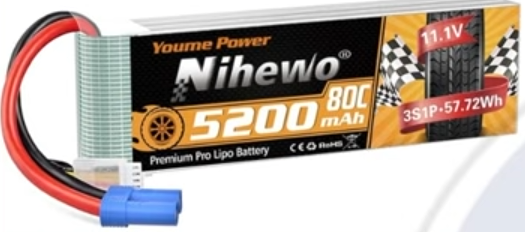
The Nihewo 5200mAh 80C LiPo is not a battery many RC enthusiasts will recognize, but its price places it directly against popular options from Ovonic. In this test, the Nihewo 3S 5200mAh pack was compared against the Ovonic 5200mAh 130C pack using a 105-amp load test. Results were normalized on a per-cell basis, allowing a fair comparison despite the different cell counts.
Test Overview
This test compares the Nihewo 5200mAh 80C against the Ovonic 5200mAh 130C using a 105-amp discharge test. Although the Nihewo is a 3S pack and the Ovonic is a 4S pack, all results are evaluated on a per-cell basis to allow a fair comparison. Key metrics include internal resistance, usable capacity, voltage retention, and average power output under load.
| Feature | Nihewo 5200mAh 80C | Ovonic 5200mAh 130C |
|---|---|---|
| Capacity | 5200mAh | 5200mAh |
| Cell Count | 3S | 4S |
| Advertised C Rating | 80C | 130C |
| Connector | EC5 | EC5 |
| Case Type | Soft Case | Soft Case |
| Internal Resistance | 5.7mΩ | 4.46mΩ |
| Calculated Real C Rating | 14.5C | 16C |
| Estimated Continuous Current | 76A | 85A |
| Intended Use | General Bashing | Higher-Power Applications |
The lower internal resistance of the Ovonic suggested it would handle the 105-amp test load more effectively, and the test results confirmed that prediction.
Internal Resistance and Real C Rating
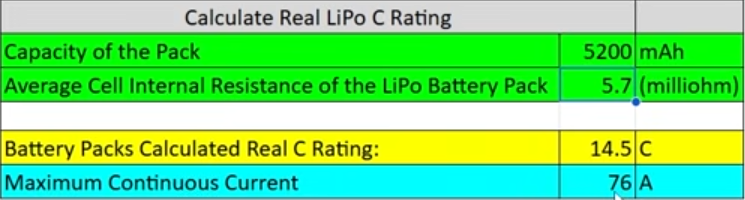
The Nihewo measured an average internal resistance of 5.7mΩ per cell, resulting in a calculated real-world C rating of 14.5C and an estimated continuous current capability of 76 amps.
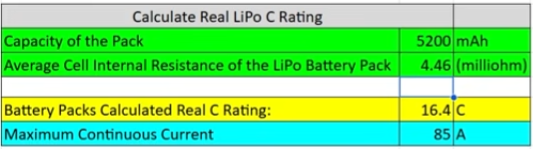
The Ovonic measured lower internal resistance at 4.46mΩ. This translated into a calculated 16C rating and an estimated continuous current capability of 85 amps. Based on resistance alone, the Ovonic entered the test as the stronger performer.
Performance Results
| Metric | Ovonic | Nihewo |
|---|---|---|
| Usable Capacity | 2910mAh | 2410mAh |
| Energy per Cell | 600 Wh-min | 488 Wh-min |
| Average Cell Wattage | 335W | 324.5W |
| Voltage at 10 Seconds | 3.54V | 3.45V |
| mAh to 3.5V | 377mAh | 129mAh |
| Time to 3.5V | 137s | 46s |
The Ovonic outperformed the Nihewo across every measured category. Usable capacity under load was approximately 17% higher, while energy output and average wattage also favored the Ovonic.

The biggest difference was voltage retention. The Nihewo reached 3.5V much sooner and delivered significantly less capacity before hitting that threshold. This indicates greater voltage sag under heavy load and reduced power availability during demanding driving conditions.
Although neither battery would be considered a top-tier performer at 105 amps, the Ovonic maintained stronger voltage and delivered more usable energy throughout the discharge cycle.
Final Thoughts
The Nihewo 5200mAh 80C delivered acceptable performance for a budget-oriented LiPo pack, but it could not match the Ovonic 5200mAh 130C in this comparison. Higher internal resistance resulted in greater voltage sag, lower usable capacity, and reduced overall performance under heavy load.
The Ovonic proved to be the better choice for drivers who demand stronger acceleration, improved voltage stability, and better performance in high-power applications. The Nihewo remains a viable option for casual bashing and lower-demand setups, but it is not the battery to choose when maximum performance is the goal.
Want the full data behind these battery tests? Join the RCexplained Battery Benchmark Squadron for access to detailed benchmark spreadsheets, internal resistance data, ranked battery comparisons, historical test data, plus the monthly RC Calculator spreadsheet and advanced data log analysis tools for Castle Creations ESCs used throughout this site. See membership options here.