
Soldering vs spot welding 21700 cells is one of the biggest debates among DIY battery builders. Spot welding is widely considered the safer method because it minimizes heat applied directly to the cells, while soldering is often criticized for the potential to damage batteries if done incorrectly.
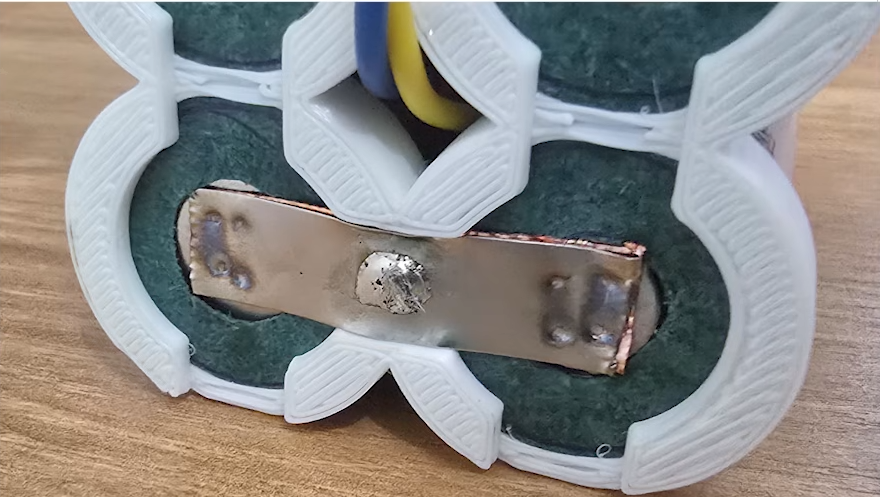
To see how much the connection method actually affects performance, I compared two identical 4S packs built from Tenpower 50XG 21700 cells. One pack was soldered using solid copper bus bars, while the other used a spot-welded copper and nickel sandwich. Both packs were tested under the same high-current load to measure voltage drop, current delivery, and usable capacity.
Test Setup
Both battery packs used identical Tenpower 50XG 5000mAh cells. The only difference was how the cells were connected.
Soldered pack
- 1 mm × 5 mm copper bus bars
- Direct soldered cell connections
Spot welded pack
- 0.3 mm copper strip with 0.2 mm pure nickel overlay
- Welded using a Kweld spot welder
- Weld quality verified with pull testing
The goal was to determine whether the connection method changed electrical performance during a demanding load test.
Internal Resistance Results
One concern with soldering is that the additional heat could permanently increase internal resistance.
The results showed very little difference.
- Soldered pack: 7.31 mΩ average per cell
- Spot welded pack: 7.00 mΩ average per cell
Using the RC Explained calculator, that small improvement only increased the estimated continuous current from approximately 65A to 67A, suggesting that soldering did not significantly degrade the cells during construction.
Performance Comparison
Under the high-current discharge test, the soldered pack consistently outperformed the welded version by a small but measurable margin.
| Metric | Soldered Pack | Spot Welded Pack |
|---|---|---|
| Usable Capacity | 1433 mAh | 1356 mAh |
| Energy per Cell | 284 Wh-min | 266 Wh-min |
| Average Cell Power | 288.5 W | 281.4 W |
| Voltage at 10 Seconds | 3.39 V | 3.28 V |
The soldered pack maintained slightly higher voltage throughout the discharge, which allowed it to deliver approximately 1.5 amps more current for much of the test.
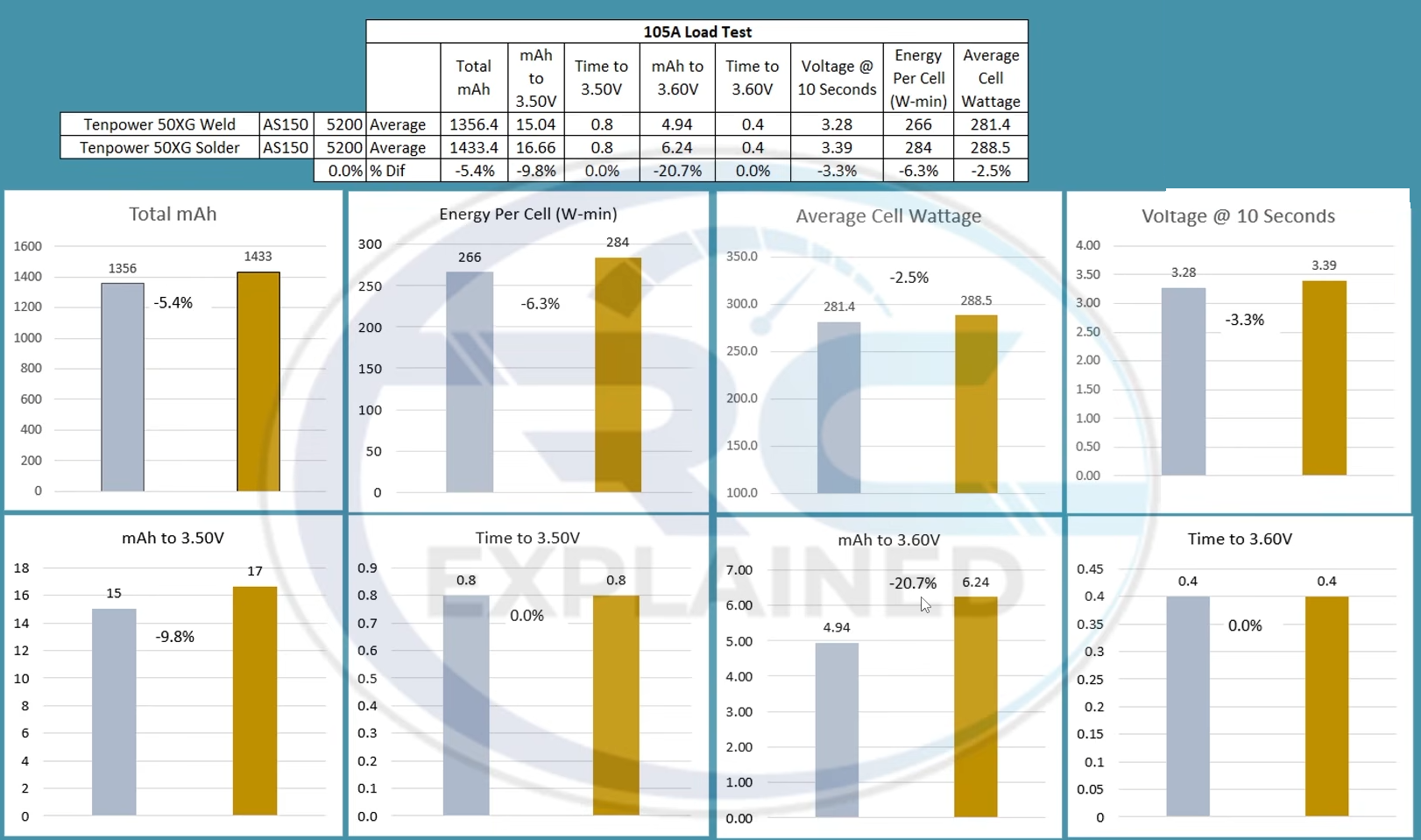
Although the differences were not dramatic, every measured performance category favored the soldered pack.
What Caused the Difference?
The additional resistance introduced by the spot-welded nickel and copper layers appears to have created a slightly larger voltage drop under heavy load.
Higher voltage means:
- More current delivered
- More usable power
- Slightly greater usable capacity
- Better overall performance during demanding applications
While the improvements were modest, they remained consistent across the entire discharge.
Practical Considerations
Performance is only one factor when choosing a construction method.
Soldering can produce lower resistance connections, but it also exposes cells to significantly more heat during assembly. Improper soldering techniques can permanently damage lithium-ion cells or create safety risks.
Spot welding remains the recommended construction method because it minimizes heat transfer into the battery while still providing strong electrical connections.
The test also highlighted another consideration for lithium-ion packs: voltage sag is much greater than with typical LiPo batteries. Anyone using these packs in an RC vehicle may need different low-voltage cutoff settings instead of reusing LiPo programming.
Final Thought
Overall, this soldering vs spot welding 21700 cells comparison shows that soldering produced slightly better electrical performance, while spot welding remains the safer construction method for most builders.
However, the performance gain was relatively small. Because spot welding is considerably safer for lithium-ion cells, it remains the preferred construction method for most builders. If maximum performance is the priority and proper soldering techniques are used, soldering may offer a slight advantage—but it comes with increased risk during pack assembly.
Want the full data behind specific battery tests? Join the RCexplained Battery Benchmark Squadron for access to detailed benchmark spreadsheets, internal resistance data, ranked battery comparisons, historical test data, plus the monthly RC Calculator spreadsheet and advanced data log analysis tools for Castle Creations ESCs used throughout this site. See membership options here.