
Upgrading your RC motor or increasing battery voltage can make your vehicle significantly faster, but it also increases current draw. If you want to predict RC motor current before installing new components, a simple calculation can provide a surprisingly good estimate. Whether you’re building an RC car, boat, airplane, or EDF jet, this method helps you estimate current and avoid overloading your ESC or battery.
The Basic Current Prediction Formula
If you already know how much current your existing setup draws, you can estimate the new current after changing motor KV or battery voltage.
The simplified formula uses:
- Existing current draw
- Original KV (or voltage)
- New KV (or voltage)
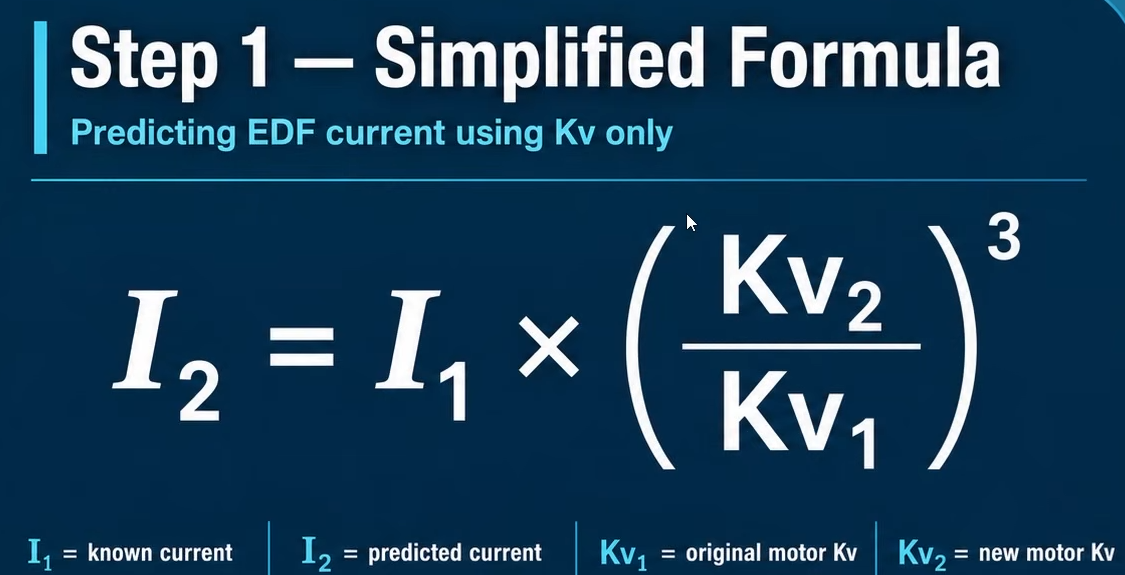
Because power requirements increase rapidly with RPM, the calculation raises the KV ratio to the third power. Even a modest increase in motor KV can produce a much larger increase in current than many hobbyists expect.
Example: Changing Motor KV
An EDF setup originally draws 85 amps using a 1050 KV motor. Replacing it with a 1250 KV motor gives an estimated current draw of approximately 143 amps using the simplified formula.
That is a dramatic increase from only a 200 KV change. It highlights why upgrading motors without checking current can easily overload an ESC or battery pack.
This same approach also works when increasing battery voltage, making it useful for almost any RC power system.
RC Cars Need One Important Adjustment
If you’re calculating current for an RC car, use the steady-state current at top speed, not the peak current seen during acceleration.
Acceleration creates short current spikes that do not represent the continuous load on the motor. Using steady-state current produces much more realistic predictions.
Why the Simple Formula Isn’t Perfect
The simplified calculation assumes the motor’s rated KV is exactly correct and that battery voltage stays constant.
Neither assumption is completely true.
During testing, several motors measured noticeably different from their advertised KV ratings. Some motors were within a few percent, while others differed by more than 7%.
Battery voltage also drops as current increases. Higher current creates more voltage sag, especially under heavy load, which changes the actual operating conditions.
These two factors explain why calculated current and real-world current do not always match perfectly.
Measuring Actual Motor KV Improves Accuracy
One way to improve your estimates is to measure the motor’s actual KV instead of relying on the number printed on the motor.
Testing showed examples such as:
- A 1050 KV motor measuring approximately 1017 KV
- A 1250 KV motor measuring approximately 1335 KV
- Some motors measuring almost exactly on specification
- Others varying by several percent
Even relatively small differences can noticeably change predicted current.
Accounting for Voltage Sag
A better prediction also includes battery voltage under load.
As current increases:
- Battery voltage decreases
- Motor speed changes slightly
- Current estimates become more realistic
Adding voltage into the calculation reduced one prediction from nearly 192 amps down to approximately 142 amps, much closer to the measured current during testing.
Including voltage sag creates a far more useful estimate for selecting batteries and ESCs.
Comparing Predictions to Real Testing
The final validation came from testing the EDF setup.
The upgraded system initially pulled just over 130 amps before settling slightly lower during sustained operation. This result closely matched the improved calculation once real motor KV and voltage under load were considered.
While no simplified equation can perfectly predict every setup, combining measured KV with loaded battery voltage produces estimates that are much closer to real-world performance.
RC Explained EDF Calculator
The RC Explained website includes an updated EDF Calculator that automates many of these calculations.
The calculator allows users to:
- Select fan size and battery configuration
- Choose from supported motors
- Estimate current, power and static thrust
- Compare different battery packs
- Save complete EDF setups for future use
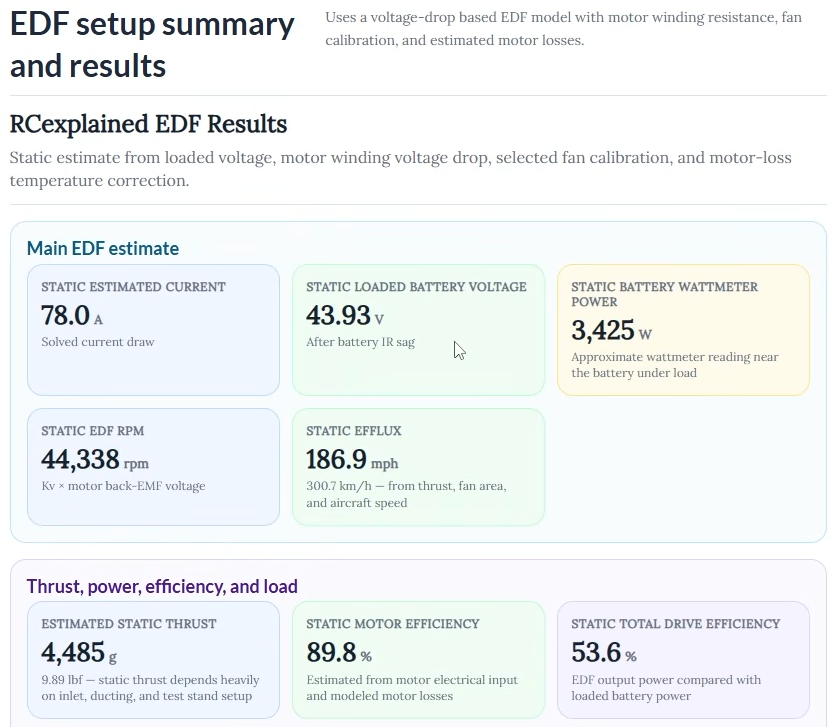
Advanced members can also select battery packs using measured performance data collected from RC Explained battery testing, providing more accurate estimates than generic specifications alone.
Final Thoughts
Learning how to predict RC motor current is one of the easiest ways to avoid damaging expensive electronics when upgrading your RC vehicle. A simple formula provides a solid starting point, while measuring actual motor KV and accounting for battery voltage under load produces much more accurate estimates.
Whether you’re upgrading an EDF jet, speed boat, RC car, or airplane, taking a few minutes to estimate current before installing new components can help you choose the right ESC, battery, and motor combination with much greater confidence.
If you’d like full access to the RC calculators, battery benchmark data, and other advanced RC tools, consider joining the Battery Benchmark Squadron or Insights membership through the RC Explained website. New calculators and features continue to be added as testing expands. View membership plans here.