During more than a decade in radio-control boating, I have watched fast electric boats change dramatically. Early electric boats relied on NiCd battery packs, followed by higher-capacity NiMH technology. The arrival of LiPo batteries and affordable brushless motors changed the hobby again by allowing far more power to be installed in a lightweight RC boat.
This was especially important in boating because moving a hull through water requires a tremendous amount of power. Water creates far more resistance than air, and an RC boat must continuously overcome that drag to remain on plane and build speed.
Before modern brushless power systems became common, it was difficult to find a ready-to-run electric boat capable of strong performance. Faster models often used two brushed motors, multiple battery packs and complicated couplings or gearboxes to drive a single propeller shaft.
Then one ready-to-run boat arrived that helped introduce a much larger group of hobbyists to practical brushless marine power.
The RCexplained Hull of Fame
The boat entering the RCexplained Hull of Fame is one that many long-time fast electric enthusiasts will remember:
The AquaCraft SuperVee 27 RTR.
The SuperVee 27 became one of the early mainstream ready-to-run brushless boats that could take advantage of improving battery technology. Many owners initially ran high-quality NiMH packs, while others later moved to LiPo power with the appropriate operating precautions.
It combined an attractive hull, aluminum running hardware, brushless power and strong out-of-the-box performance at a price that made fast electric boating accessible to more hobbyists.
Why Was It Called the SuperVee 27?
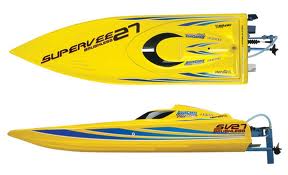
The “27” in SuperVee 27 referred to the hull’s approximate 27-inch length. That size was an important part of the boat’s success.
Hull length must be matched to the weight, power system and intended water conditions. A smaller hull can be extremely quick but may become difficult to control in wind or rough water. A larger hull generally offers more stability, but it also requires additional power to achieve the same level of performance.
At approximately 27 inches, the SuperVee was compact enough to remain lightweight and responsive while still providing useful stability at speed.
Running Hardware
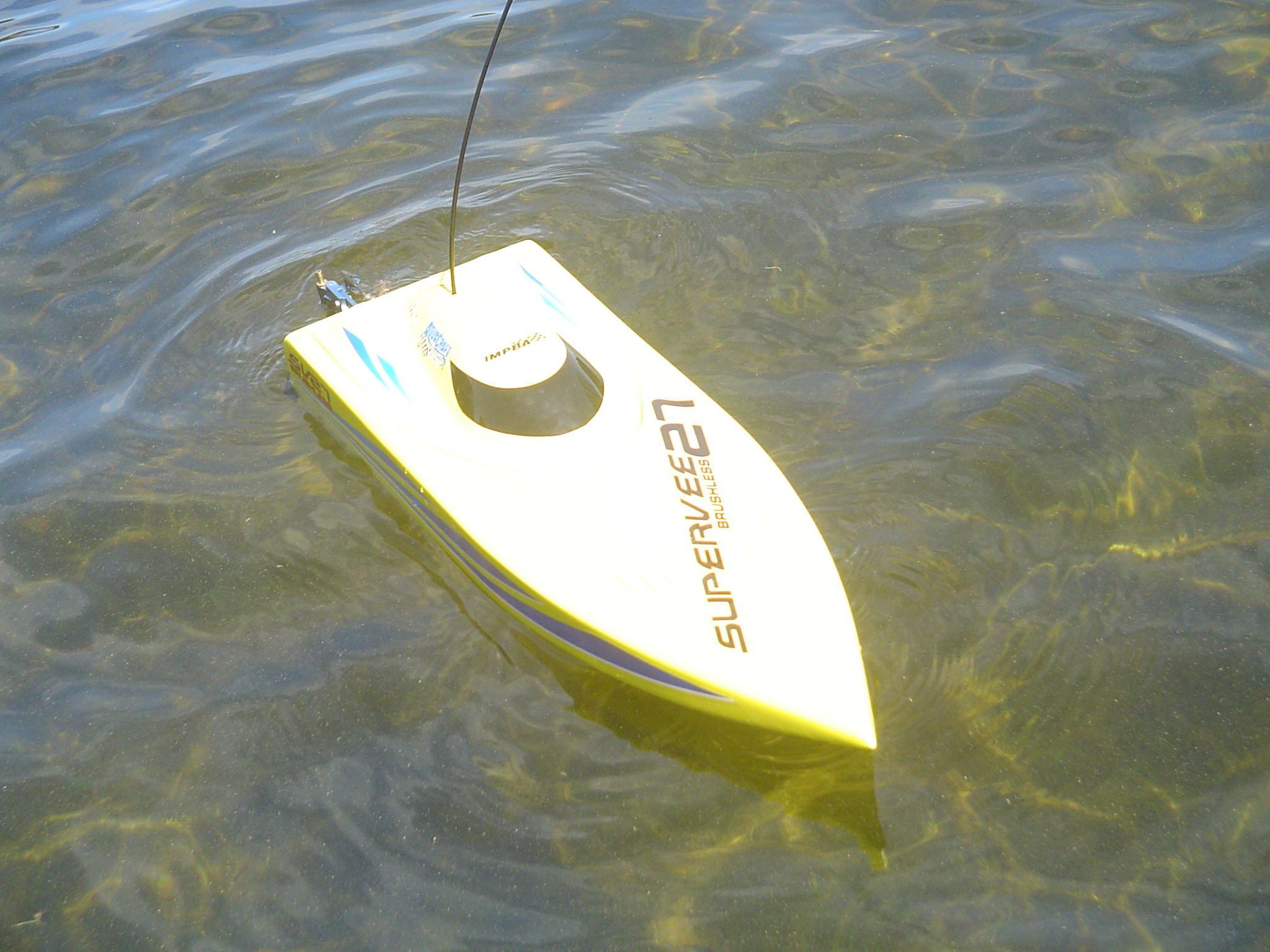
The blue-anodized aluminum running hardware was one of the SuperVee 27’s most recognizable features. The rudder, turn fin, strut and related components gave the boat a more serious appearance than many ready-to-run electric boats available at the time.
The size and placement of the running hardware also contributed to the boat’s predictable handling. It was designed primarily for clockwise circuit operation and used a right-side turn fin to support aggressive right-hand cornering.
One commonly discussed issue involved limited cooling-water flow through the rudder pickup on some early boats. Later hardware revisions reportedly improved the pickup arrangement. My own boat continued to operate successfully, but cooling flow was always something worth checking before a full-power run.

An Early Mainstream Brushless Power System
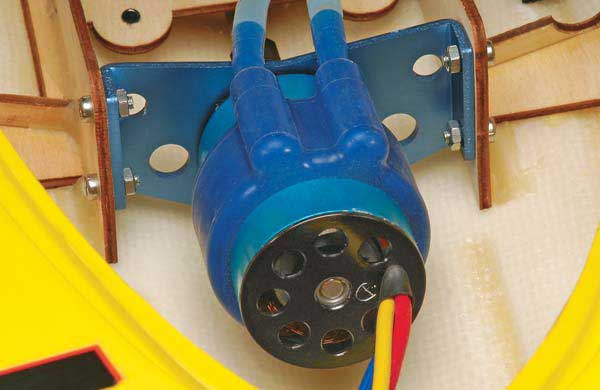
Opening the hatch revealed one of the most important parts of the SuperVee 27: a factory-installed brushless motor.
Brushless motors were already known within specialist RC communities, but many hobbyists had never used one—especially in a ready-to-run boat. The three motor wires created plenty of questions for owners who were familiar only with two-wire brushed motors.
The motor produced roughly three-quarters of a horsepower according to the original marketing used around the boat. More importantly, it demonstrated how much performance a compact brushless motor could provide without the weight and mechanical complexity of a twin-brushed-motor setup.
Electronic Speed Control and Battery Use
The original electronic speed control was designed during a period when NiMH batteries were still widely used. It did not provide the same LiPo-specific low-voltage protection expected from a modern marine ESC.
Owners who converted the boat to LiPo power therefore had to manage the battery carefully. Common options included:
- Using a reliable run timer
- Measuring the capacity returned during charging
- Installing a separate low-voltage alarm or cutoff device
- Upgrading to a LiPo-compatible marine ESC
Timing a run is still a useful practice today. Even when an ESC includes low-voltage cutoff, the cutoff should be treated as backup protection rather than the normal signal to end every run.
A useful starting point is to establish a run time that uses no more than approximately 80% of the battery’s labelled capacity while keeping the motor, ESC and battery within reasonable temperature limits.
Putting the Complete Boat Together

The complete boat originally sold for approximately $300 USD, depending on the retailer and time of purchase. For that price, it provided a combination of features that was uncommon in a mass-produced ready-to-run electric boat:
- A brushless motor
- Marine electronic speed control
- Aluminum running hardware
- A surface-drive system
- Water cooling
- A fiberglass monohull
- Strong ready-to-run performance
The boat’s handling was one of its strongest characteristics. Right-hand turns were smooth and predictable when the hull was properly balanced and the water conditions were suitable.
The right-side turn fin meant aggressive right-hand cornering was the boat’s specialty. Left-hand turns required more care, which was normal for a setup designed around clockwise racing.
Depending on the battery, propeller, setup and water conditions, owners reported speeds in the range of approximately 55 to 64 km/h. Those figures were impressive for a ready-to-run electric boat of that era.
Why the SuperVee 27 Mattered
The SuperVee 27 helped demonstrate that a ready-to-run electric boat could be genuinely fast without requiring an experienced builder to assemble a custom brushless power system.
It arrived during an important transition:
- Brushless motors were becoming more affordable.
- LiPo batteries were becoming practical for mainstream RC use.
- Marine ESCs were improving.
- Hobbyists wanted ready-to-run boats with real performance.
After boats such as the SuperVee 27 proved there was demand, the ready-to-run fast electric market expanded rapidly. Modern RC boaters now have access to larger hulls, higher voltages, more powerful ESCs, telemetry, data logging and speeds that would have seemed extreme when this boat was introduced.
How It Compares With Modern Fast Electric Boats
A modern ready-to-run boat may provide more power, stronger cooling, LiPo-compatible electronics and higher advertised speed. However, the SuperVee 27 should be viewed in the context of the market in which it appeared.
Its importance was not that it remained the fastest boat forever. Its importance was that it gave a large number of hobbyists an affordable and relatively straightforward introduction to brushless fast electric boating.
Setting Up a Similar Fast Electric Boat Today
A modern version of this type of setup should be selected using the complete hull, battery, motor, ESC and propeller combination rather than copying one specification in isolation.
The following RCexplained resources can help:
- Guide for Successful Electric Boating
- RC FE Boat Setup Calculator
- RC Boat Speed Calculator
- RC Boat Propeller Database
Begin with a conservative propeller, complete a short on-water test, and immediately check motor, ESC and battery temperatures. Increase the load only after the system has been verified.
Hull of Fame Conclusion
The AquaCraft SuperVee 27 deserves a place in the RCexplained Hull of Fame because it helped bridge the gap between specialist-built fast electric boats and mainstream ready-to-run models.
It combined a practical hull size, distinctive running hardware and factory-installed brushless power into a package that many hobbyists could purchase, launch and enjoy.
Modern boats may be faster and more advanced, but the SuperVee 27 helped open the door. For many RC boaters, it was the model that showed what ready-to-run brushless boating could become.