
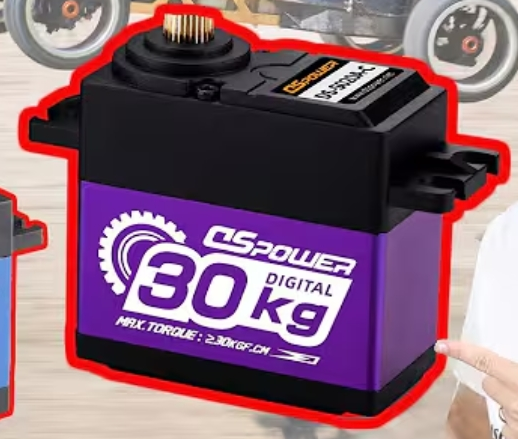
Digital servos have become a must-have upgrade for RC enthusiasts, offering performance advantages that analog servos simply can’t match. In this post, I’ll break down the top 5 reasons why digital units are critical for your vehicles and why they’re now accessible to nearly every hobbyist thanks to lower prices and increased competition.
1. High Precision and Faster Response Time
Digital servos process output signals much faster than analog servos. While analog units typically operate around 50 Hz, digital servos often run at 300 Hz or more, allowing for finer control and quicker response to your inputs. This frequency is to the electric motor inside the servo, not the input signal to the servo. This faster processing makes a noticeable difference when you need precise positioning and control over your RC vehicle, especially in demanding applications.
2. Stronger Holding Power
One of the biggest advantages of digital servos is their ability to maintain consistent positioning under load. Even when forces try to move the servo away from its requested position, digital units send far more pulses to the motor, keeping the arm locked in place.
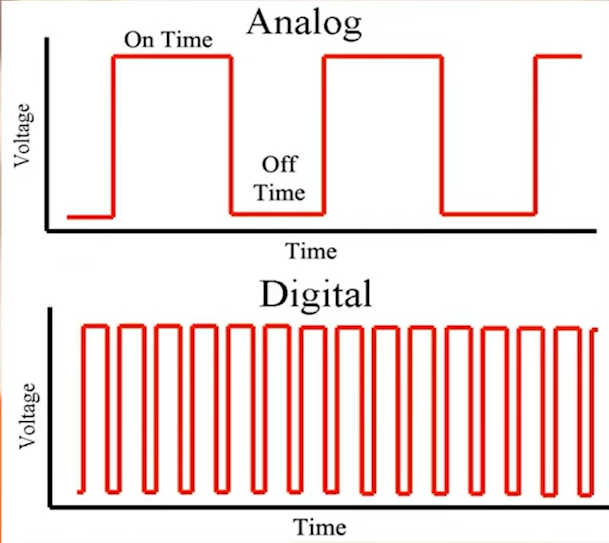
Analog servos, by contrast, require more deviation to apply the same corrective torque, making digital servos far superior for steering or controlling critical surfaces. Even if the input signal is the same as analog, the output control within the digital servo ensures precise and consistent positioning.
3. Full Torque Across the Range
Digital servos can apply maximum torque at any position within their range. This is especially important when you want to hold a position at the extremes of the servo range. Because digital servos send more frequent pulses to the motor, they eliminate dead spots, ensuring reliable torque and control wherever the arm is positioned.
4. Smoother Operation
With digital servos, movement is smooth and jitter-free. The higher PWM frequency allows fine adjustments that minimize abrupt jumps and create seamless transitions. This is particularly important for applications requiring precise and stable control, such as throttle, rudder, or aileron adjustments in aircraft or steering inputs in cars.
5. Improved Accessibility and Cost
Digital units have become affordable for nearly all hobbyists, narrowing the price gap with analog units. With more competition in the market, it’s now easier than ever to get high-performance servos with excellent torque and speed without breaking the bank. This makes it feasible to upgrade existing vehicles or replace old analog servos with high-quality digital units.
Digital vs Analog Servo Overall Comparison
| Reason | Analog Servo | Digital Servo |
|---|---|---|
| 1. Precision & Response Time | Drive (output)Signal at ~50 Hz; slower response | Drive (output)Signal at ~300 Hz or more; faster, finer control |
| 2. Holding Power | Weaker under load; needs more movement to correct position | Strong holding power; maintains position under stress |
| 3. Torque Across the Range | Torque varies; dead spots possible | Maximum torque across all positions; no dead spots |
| 4. Smooth Operation | Can jitter; less smooth transitions | Smooth transitions; minimal jitter due to higher PWM frequency |
| 5. Cost & Accessibility | Lower cost; widely available | Slightly higher cost but more affordable than before; high performance accessible |
This chart highlights why digital servos are preferred for any application requiring accuracy, consistency, and strong holding power.
Final Thoughts
Digital servos deliver clear advantages in precision, holding power, torque, and smoothness, making them indispensable for modern RC vehicles. Combined with their increasingly accessible cost, there’s very little reason to stick with analog servos for new builds or upgrades.
If you’re using analog servos in older vehicles, consider swapping them out for high-performance digital units to get more consistent control and a better overall driving or flying experience.