
Does propeller material make a measurable difference in the performance of an RC boat or RC airplane? In many cases, it can—but the answer depends on far more than simply choosing the strongest material available.
A propeller must maintain its intended blade shape while rotating at high RPM and producing thrust. If the blades flex excessively, their effective pitch and angle of attack can change. This may affect acceleration, efficiency, sound, handling and top speed.
For RC airplanes, is carbon fibre worth the extra cost compared with wood or reinforced composite? For RC boats, is stainless steel worth choosing over aluminum or plastic? Let’s examine how material properties can influence propeller performance.
Propeller Strength, Stiffness and Deflection
Propeller material discussions often use the words strength and stiffness as though they mean the same thing. They are related, but they describe different material properties.
- Strength describes how much stress a material can withstand before it permanently deforms or fails.
- Stiffness describes how resistant a material is to elastic bending or deflection under load.
- Yield strength is the stress level at which permanent deformation begins.
- Fatigue strength relates to how well a material survives repeated loading cycles.
A material can have high strength but still deflect more than another material under the same load. Propeller performance is often influenced more directly by blade stiffness and geometry than by ultimate material strength alone.
Consider a ruler held firmly at one end while force is applied to the other. The applied force creates internal stress, and the ruler bends in response. If the load is removed before the yield point is reached, the ruler should return to its original shape. If the yield point is exceeded, permanent deformation can remain.
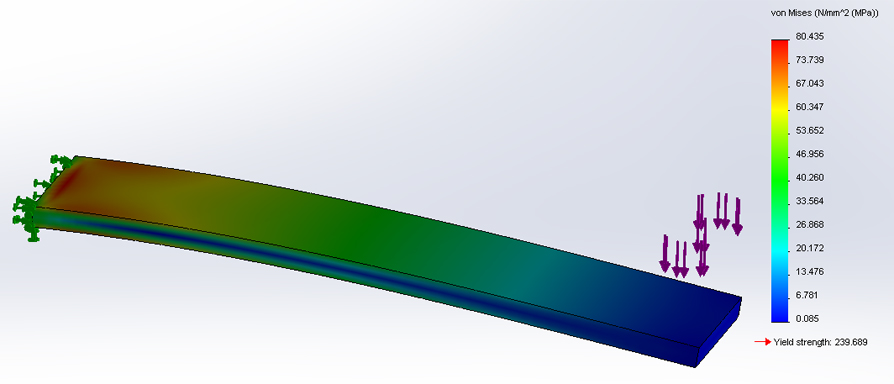
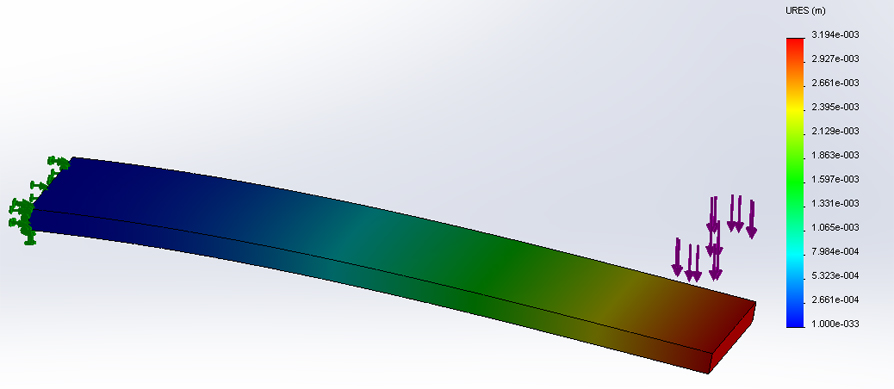
These images illustrate general engineering concepts. They are not a complete simulation of an operating propeller. A real propeller experiences centrifugal force, bending, torsion, vibration and changing aerodynamic or hydrodynamic pressure across the blade.
What Loads Act on a Propeller?
An operating propeller is subjected to several loads at the same time:
- Centrifugal loading: Rotation pulls the blade material outward from the hub.
- Bending load: The thrust produced by the blade attempts to bend it.
- Torsional load: Motor torque and blade pressure attempt to twist the blade.
- Vibration: Imbalance, shaft alignment and uneven loading produce cyclic stress.
- Impact loading: Boat propellers may strike debris, while airplane propellers may contact the ground.
- Cavitation or aerodynamic effects: Changing pressure around the blade can create additional vibration and unsteady loading.
As RPM increases, many of these stresses rise rapidly. Centrifugal loading is especially sensitive to rotational speed, which is why every propeller must be used within the manufacturer’s recommended RPM and power limits.
How Propeller Deflection Can Affect Performance
If a propeller blade flexes while operating, its effective geometry changes. The blade may no longer maintain the same pitch, rake, cup or angle of attack that it had while stationary.
Excessive deflection can potentially contribute to:
- Reduced effective pitch
- Lower thrust
- Reduced acceleration
- Increased slip
- Changes in lift or hull attitude
- Changes in engine or motor load
- Additional vibration or noise
- Reduced efficiency
Some blade flex is not automatically harmful. A propeller may be intentionally designed with controlled flexibility. The important question is whether the blade maintains the intended shape and remains structurally safe throughout its operating range.
Simplified Aluminum and Stainless-Steel Comparison
The images below compare the calculated displacement of two simplified 46 mm boat propeller models subjected to the same assumed blade load. One model uses stainless-steel material properties, while the other uses aluminum properties.
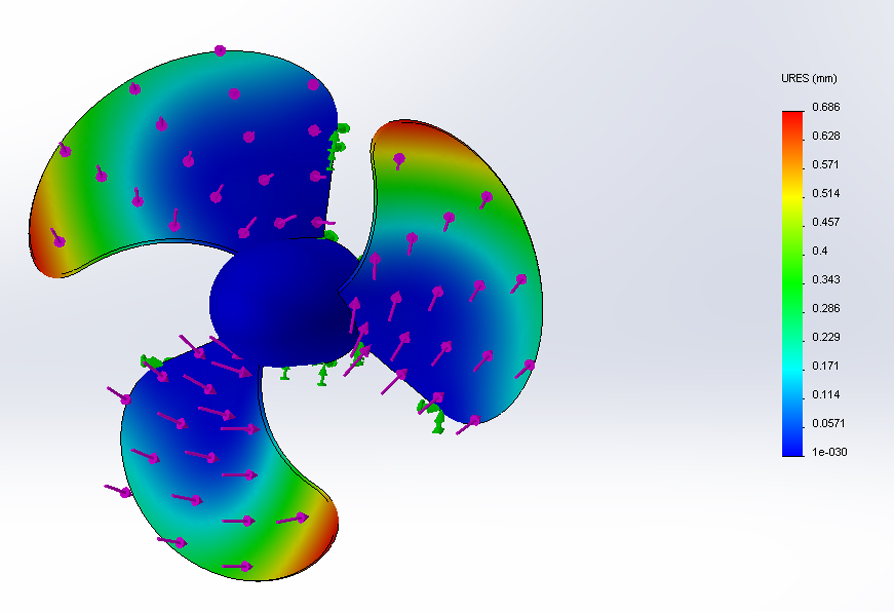
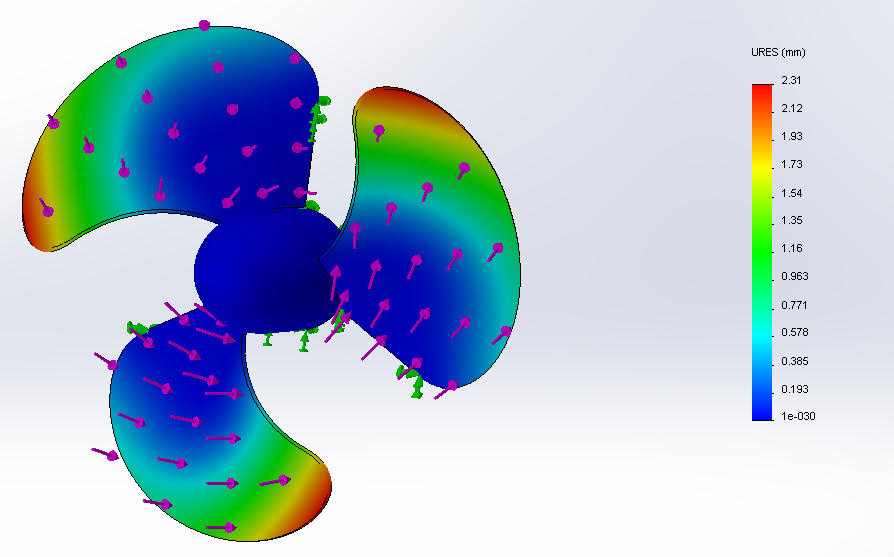
In this simplified comparison, the stainless-steel model deflects less under the same assumed load. This is primarily a stiffness comparison rather than proof that every stainless-steel propeller will outperform every aluminum propeller.
The result of a real propeller comparison also depends on:
- Blade thickness
- Blade shape and area
- Pitch and cup
- Hub design
- Material alloy and heat treatment
- Manufacturing quality
- Balance
- Surface finish
- Operating RPM
- Propeller loading
A thick aluminum propeller may be stiffer than a very thin propeller made from a stronger material. Geometry can have as much influence as the material itself.
RC Boat Propeller Materials
Plastic and Reinforced Composite
Plastic and reinforced-composite propellers are inexpensive, lightweight and suitable for many ready-to-run and lower-power boats. They can also act as a relatively inexpensive failure point if the propeller strikes an object.
Possible limitations include greater blade flex, less precise manufacturing and lower resistance to very high RPM or power.
Aluminum
Aluminum propellers are generally lightweight and affordable. They are used successfully in many sport and performance applications.
Compared with stainless steel, aluminum is normally less stiff and more easily damaged by impact. However, a properly designed aluminum propeller may still perform very well when matched to the power system.
Stainless Steel
Stainless-steel propellers can use thinner blades while maintaining high stiffness and strength. This can help the blade maintain its intended geometry under heavy load.
They are normally more expensive and heavier than aluminum or plastic propellers. Their greater strength can also transfer more impact load into the shaft, strut, bearings or driveline if the propeller strikes an object.
Beryllium-Copper and Other Racing Alloys
Some high-performance RC boat propellers use specialized copper-based alloys or other materials selected for a combination of strength, stiffness, workability and fatigue resistance.
These propellers are often supplied unfinished and may require sharpening, balancing and polishing before use. Propeller preparation should be completed carefully because an incorrectly prepared or unbalanced propeller can be dangerous at high RPM.
RC Airplane Propeller Materials
Wood Propellers
Wood propellers are lightweight and can provide excellent performance. Their low rotating mass can produce smooth throttle response and reduce some of the load transferred during a propeller strike.
Wood propellers must be protected from moisture and inspected for cracks, compression around the hub and damage to the blade edges.
Glass-Reinforced Composite Propellers
Glass-reinforced composite propellers are common, affordable and durable. They are suitable for a wide range of sport and electric-airplane applications.
The exact stiffness and performance vary considerably between manufacturers and propeller families. A reinforced composite propeller should not be treated the same as an inexpensive flexible plastic propeller.
Carbon-Fibre Propellers
Carbon-fibre propellers can provide high stiffness at a relatively low weight. They are commonly used in high-power, aerobatic, multirotor and competition applications.
They are more expensive and can suffer hidden internal damage after an impact. A carbon propeller that has struck the ground or another object should be inspected carefully and replaced when there is any doubt about its condition.
Does a Stiffer Propeller Always Produce More Speed?
No. A stiffer propeller may maintain its intended pitch more accurately, but that does not guarantee that it is the best propeller for the setup.
A different material may also change:
- Blade thickness
- Rotating mass
- Pitch distribution
- Blade area
- Motor current
- Acceleration
- Handling
A stiffer or more aggressive propeller may increase motor load and current. It is possible to gain a small amount of speed while producing a much larger increase in motor, ESC or battery temperature.
Any propeller change should be evaluated as a complete power-system change.
How to Compare Two Propellers
The best way to compare propeller materials is to test complete propellers under the same conditions. Avoid changing several setup variables at the same time.
- Confirm both propellers are appropriate for the motor, RPM and application.
- Balance each propeller correctly.
- Use the same battery, motor, ESC and vehicle setup.
- Record loaded RPM, current and battery voltage.
- Measure motor, ESC and battery temperature immediately after the test.
- Record acceleration, handling and top speed.
- Inspect both propellers for deformation or damage.
For an RC boat, compare performance over the same water conditions and course direction. For an airplane, account for wind, battery state of charge and flight path.
Choosing the Right Propeller Material
The best material depends on the power level, performance target, budget and operating environment.
| Application | Useful Starting Choice | Reason |
|---|---|---|
| Beginner or low-power sport use | Plastic, reinforced composite or wood | Affordable, lightweight and widely available |
| General sport boating | Composite or aluminum | Reasonable balance of cost and performance |
| High-power RC boat | Prepared metal propeller rated for the setup | Improved stiffness and blade-shape control |
| Sport RC airplane | Wood or reinforced composite | Good performance without unnecessary cost |
| High-power or competition airplane | High-quality wood, reinforced composite or carbon fibre | Material and design selected for RPM, power and stiffness requirements |
Do not select a propeller based only on material. The propeller must also have the correct diameter, pitch, blade count, hub size, RPM rating and intended application.
Use the RCexplained Propeller Tools
The following RCexplained tools can help compare the complete power system:
- RC Boat Propeller Database — compare available boat propeller sizes and specifications.
- RC FE Boat Setup Calculator — evaluate motor, battery and propeller combinations.
- RC Boat Speed Calculator — compare loaded RPM, pitch, slip and estimated speed.
- RC Airplane Power Calculator — compare airplane motor and propeller combinations.
Propeller Inspection and Safety
A damaged or unbalanced propeller can fail at high RPM. Inspect the propeller before every operating session.
- Look for cracks, chips, bent blades and hub damage.
- Confirm the propeller is balanced.
- Use the correct adapter and mounting hardware.
- Do not exceed the manufacturer’s RPM limit.
- Replace a propeller after a significant impact when its condition is uncertain.
- Keep people clear of the propeller plane whenever the motor is powered.
Conclusion
Propeller material can influence RC boat and airplane performance, but the result is not controlled by material strength alone. Stiffness, geometry, balance, pitch, blade thickness and manufacturing quality all contribute to how well a propeller maintains its shape under load.
A stronger and stiffer material may be worthwhile for a high-power or competition setup. For general sport use, a less expensive propeller may provide all the performance required.
The most reliable approach is to begin with a propeller recommended for the application, measure current and temperature, and compare alternatives through controlled testing. The best propeller is the one that delivers the required performance without overloading the motor, ESC, battery or driveline.
Pingback: RC Hobby Blog