
Choosing the wrong connector setup can hurt both the performance and reliability of your RC vehicle. One common LiPo battery connector mistake is relying on connector adapters instead of using the correct connector throughout your power system. While adapters may seem convenient, they introduce extra resistance, generate additional heat, and can increase the risk of ESC failure in high-power applications.
Why Connector Adapters Cause Problems
Every connector and every piece of wire adds electrical resistance. When you install a connector adapter, you introduce another connection point and additional wire into the power system.
This extra resistance causes:
- Voltage drop
- Reduced power output
- Additional heat generation
- Lower overall efficiency
The effects become much more noticeable in RC vehicles that regularly draw over 100 amps, such as large RC cars, EDF jets, speed boats, and high-performance aircraft.
Heat Is the Biggest Concern
One of the largest drawbacks of using an adapter is the additional heat it creates.
Testing has shown that an EC5 connector operating at continuous high current can exceed 80°C during a full battery discharge. That heat doesn’t stay inside the connector—it travels through the battery leads and into the LiPo battery itself.
Excessive connector temperatures can:
- Waste power as heat
- Reduce system efficiency
- Increase battery temperatures
- Shorten connector lifespan
For high-current systems, minimizing unnecessary resistance is one of the easiest ways to improve reliability.
Every Adapter Adds Another Failure Point
A connector adapter doesn’t just increase resistance—it also adds another mechanical connection that can potentially fail.
If an adapter becomes loose or develops a poor connection:
- Power delivery may become intermittent.
- Performance can drop unexpectedly.
- An RC airplane could lose motor power during flight.
In aircraft, losing the main power system can quickly become a serious problem, even if receiver power remains available through a separate BEC.
Adapters Can Reduce Top Speed
Every volt lost across a connector is a volt that never reaches the motor.
As voltage decreases:
- Motor RPM decreases.
- Available power decreases.
- Top speed decreases.
The larger the current draw, the greater the voltage drop across the adapter.
While this loss may be small in lower-powered systems, it becomes much more noticeable in vehicles drawing well over 100 amps.
Connector Adapters Can Increase Ripple Voltage
Another important consideration is ripple voltage.
Adding wire length between the battery and the ESC increases inductance within the power system. Connector adapters effectively increase this distance and can contribute to higher ripple voltage.
ESC manufacturers often include external capacitor packs specifically to reduce these voltage fluctuations.
Without adequate capacitance:
- Ripple voltage increases.
- ESC MOSFETs experience greater electrical stress.
- The likelihood of ESC failure increases.
This is one reason why extending battery leads without proper capacitor support is generally discouraged in high-power RC systems.
A Better Solution: Standardize Your Connectors
The simplest solution is to use the same connector throughout your RC fleet.
Instead of relying on adapters, replace the factory connector on new batteries with the connector used by your ESC.
For example:
- Use AS150 connectors for larger, high-current models.
- Use XT60 connectors for smaller power systems.
Standardizing connectors eliminates unnecessary adapters while reducing resistance and simplifying battery compatibility across multiple vehicles.
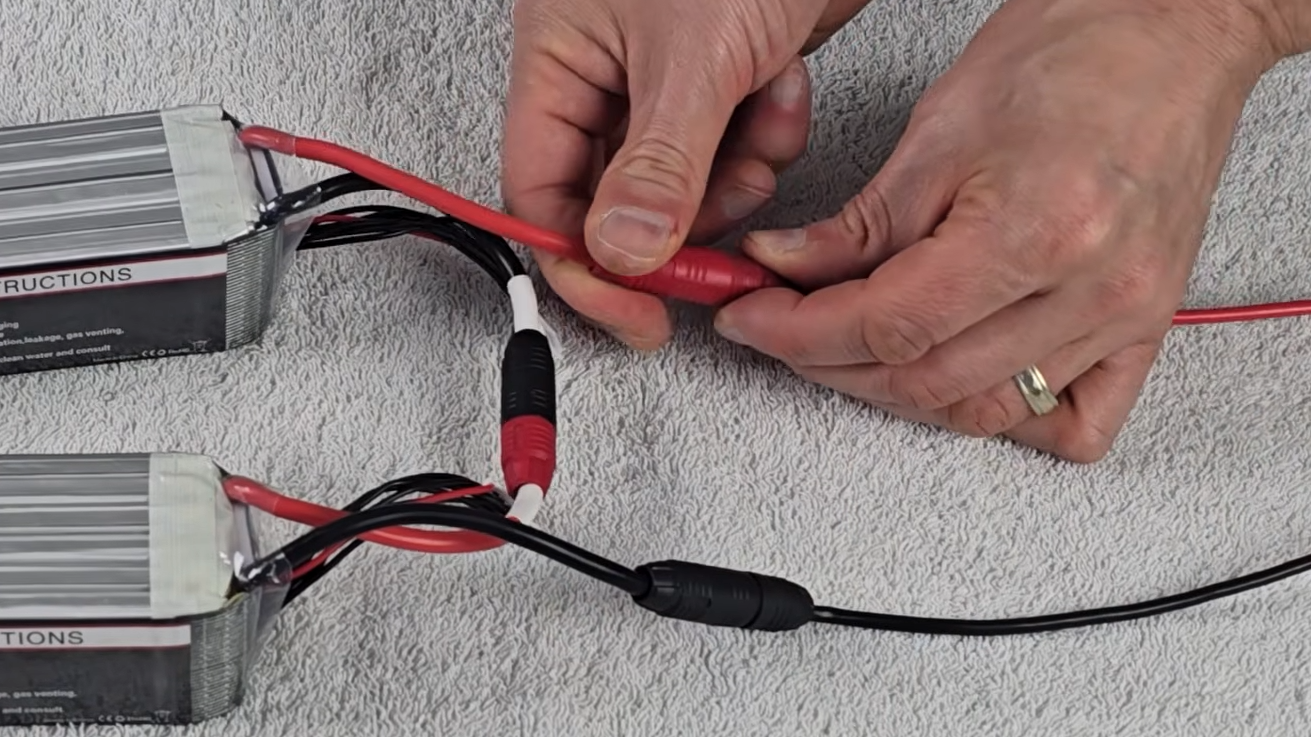
A Better Way to Connect Battery Packs in Series
Many hobbyists use series adapters to combine two battery packs.
While these work, they also introduce additional resistance and another connection into the power system.
An alternative approach is to configure batteries so they connect directly together using matching connectors. This reduces the number of electrical connections and eliminates the resistance introduced by a separate series adapter.
If using this method, clearly mark the battery leads to prevent accidentally connecting a battery to itself, which can cause immediate damage.
What If You Must Use an Adapter?
Sometimes changing connectors isn’t practical, and an adapter is the only option.
If that’s the case:
- Monitor connector temperature after each run.
- Check battery temperature for signs of heat transfer.
- Watch for voltage-related performance issues.
- Consider adding an external capacitor pack if battery leads are extended.
Lower-powered systems are generally more forgiving, but it is still worth checking connector temperatures to ensure everything remains within a safe operating range.
Final Thoughts
Avoiding this LiPo battery connector mistake can improve both the performance and reliability of your RC power system. While connector adapters offer convenience, they also introduce additional resistance, generate extra heat, reduce available power, and may contribute to higher ripple voltage in demanding applications.
Whenever possible, standardize the connectors across your batteries and ESCs instead of relying on adapters. A little extra soldering up front can result in cooler operation, better efficiency, and a more reliable RC vehicle over the long term.
If you’d like full access to the RC calculators, battery benchmark data, and other advanced RC tools, consider joining the Battery Benchmark Squadron or Insights membership through the RC Explained website. New calculators and features continue to be added as testing expands. View membership plans here.