
Internal resistance is one of the most talked-about metrics in RC batteries. But how much does it actually affect performance?
If two batteries have slightly different internal resistance values, should you expect a big difference on the track—or barely notice anything?
The answer depends entirely on where those batteries fall on the performance spectrum. In this post, I’ll break down how internal resistance translates to real-world performance, and why small changes can sometimes mean massive gains.
The Big Picture: Internal Resistance and Performance
When comparing battery packs, there is a clear relationship:
- Lower internal resistance = higher performance
- Higher internal resistance = lower performance
This relationship shows up consistently in both:
- Internal resistance testing
- Loaded performance testing
The correlation between the two is strong. As resistance drops, performance improves.
But the rate of improvement is not constant.
Why the Difference Isn’t Always Equal
The key idea is simple: A small change in internal resistance does not always produce the same change in performance.
It depends on whether you’re looking at:
- High internal resistance (lower-performing packs)
- Mid-range resistance
- Very low resistance (high-performance packs)
Let’s break each down.
High Internal Resistance: Small Gains
At the higher end (around 6–7.5 milliohms), performance differences are minimal.
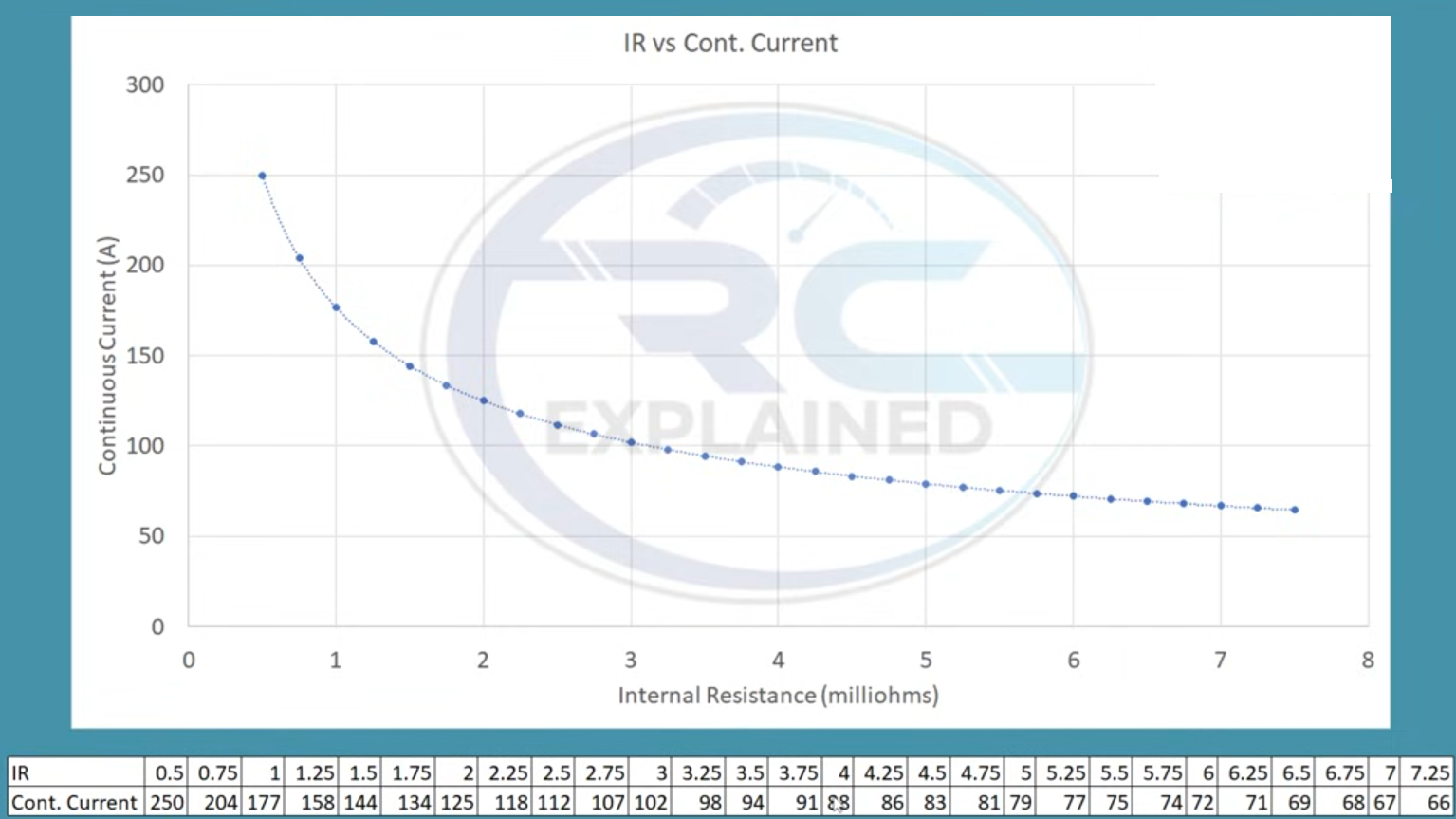
For example:
- 6 mΩ ≈ 72 amps
- 7 mΩ ≈ 67 amps
That’s only about a 5-amp difference. Even though the resistance changed, the performance gain is subtle. This is because the percentage change in resistance is small.
Mid-Range Internal Resistance: Noticeable Gains
In the middle range (around 3–4 milliohms), differences become more noticeable.
For example:
- 3 mΩ ≈ 102 amps
- 4 mΩ ≈ 88 amps
Now you’re looking at a 14-amp difference. That’s a bigger jump, even though the resistance only changed by 1 milliohm. This is where improvements start to matter more in real-world use.
Low Internal Resistance: Massive Gains
At the low end, things change dramatically.
For example:
- 1.5 mΩ ≈ 144 amps
- 0.5 mΩ ≈ 250 amps
That’s over a 100-amp increase from a small resistance drop.
Here’s why:
- Dropping from 1.0 to 0.5 mΩ cuts resistance in half
- That’s a 50% reduction, not a small change
- Less resistance = less heat loss
- More energy goes directly into usable power
This is where performance gains become huge.
Why This Happens
It all comes down to percentage change, not absolute change.
A drop of 0.5 mΩ can mean very different things:
- From 7 → 6.5 mΩ = small percentage change
- From 1 → 0.5 mΩ = massive percentage change
When resistance drops significantly:
- Heat losses decrease
- Efficiency increases
- Current output rises sharply
That’s why high-performance packs benefit the most from small improvements.
How Battery Capacity Affects Internal Resistance
One important detail: these examples are based on 5000mAh battery packs.
Capacity changes everything.
- Smaller packs (e.g., 2200mAh):
Higher internal resistance
Shift toward the higher end of the scale - Larger packs (e.g., 10,000mAh):
Lower internal resistance
Shift toward the lower end
So when comparing batteries, always consider capacity alongside resistance.
Key Takeaways
- Internal resistance strongly correlates with performance
- Small differences matter more at lower resistance values
- High resistance → small performance changes
- Low resistance → massive performance gains
- Capacity affects where a battery falls on the scale
Final Thoughts
Internal resistance is one of the best indicators of battery performance—but only if you understand how to interpret it.
A small difference isn’t always meaningful. But in the right range, it can completely change how a battery performs.
That’s why context matters more than the number itself.
Want the full data behind these battery tests? Join the RCexplained Battery Benchmark Squadron for access to detailed benchmark spreadsheets, internal resistance data, ranked battery comparisons, historical test data, plus the monthly RC Calculator spreadsheet and advanced data log analysis tools for Castle Creations ESCs used throughout this site. See membership options here.