
In this Hoovo vs Ovonic a 100C 5200mAh Battle, we are comparing two 4S LiPo packs under a 105A load test. On paper, the Hoovo is rated at 100C, while the Ovonic is rated slightly higher at 130C. Both packs also share similar specs, including 5200mAh capacity, soft cases, and EC5 connectors.
However, instead of focusing on ratings, the real question is how each pack performs under sustained high current draw.
Battery Test Group
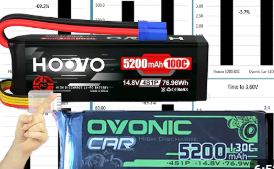
To ensure a fair comparison, both batteries were tested under identical 105A discharge conditions. As a result, any differences you see come directly from the packs themselves.
Interestingly, the Hoovo is marketed around higher C rating expectations. In contrast, the Ovonic is known more for value-oriented performance.
Because of that, this Hoovo vs Ovonic a 100C 5200mAh Battle gives a good contrast between “rated performance” and “real performance.”
Internal Resistance
Internal resistance was measured using a 1.5C charge rate (7.8A for a 5200mAh pack). For consistency, readings were taken at approximately the 1-minute mark.
From the measurements, the Hoovo averaged 4.14 mΩ per cell.
Based on that result, the estimated real-world discharge capability comes out to roughly 17C (~89A continuous).
Even though the label suggests 100C performance, in practice the pack behaves much lower under sustained load. As a result, voltage drop becomes more noticeable during the discharge cycle.
| Metric | Hoovo | Ovonic | Winner |
|---|---|---|---|
| Usable Capacity (mAh) | 98.5 | 2900 | Ovonic |
| Energy per Cell | 185 | 600 | Ovonic |
| Avg Cell Wattage | 314 | 335 | Ovonic |
| 10s Voltage | 3.41V | 3.54V | Ovonic |
| mAh to 3.5V | 109 | 377 | Ovonic |
| Time to 3.5V | 4.2s | 13.7s | Ovonic |
| mAh to 3.6V | <7 | 63 | Ovonic |
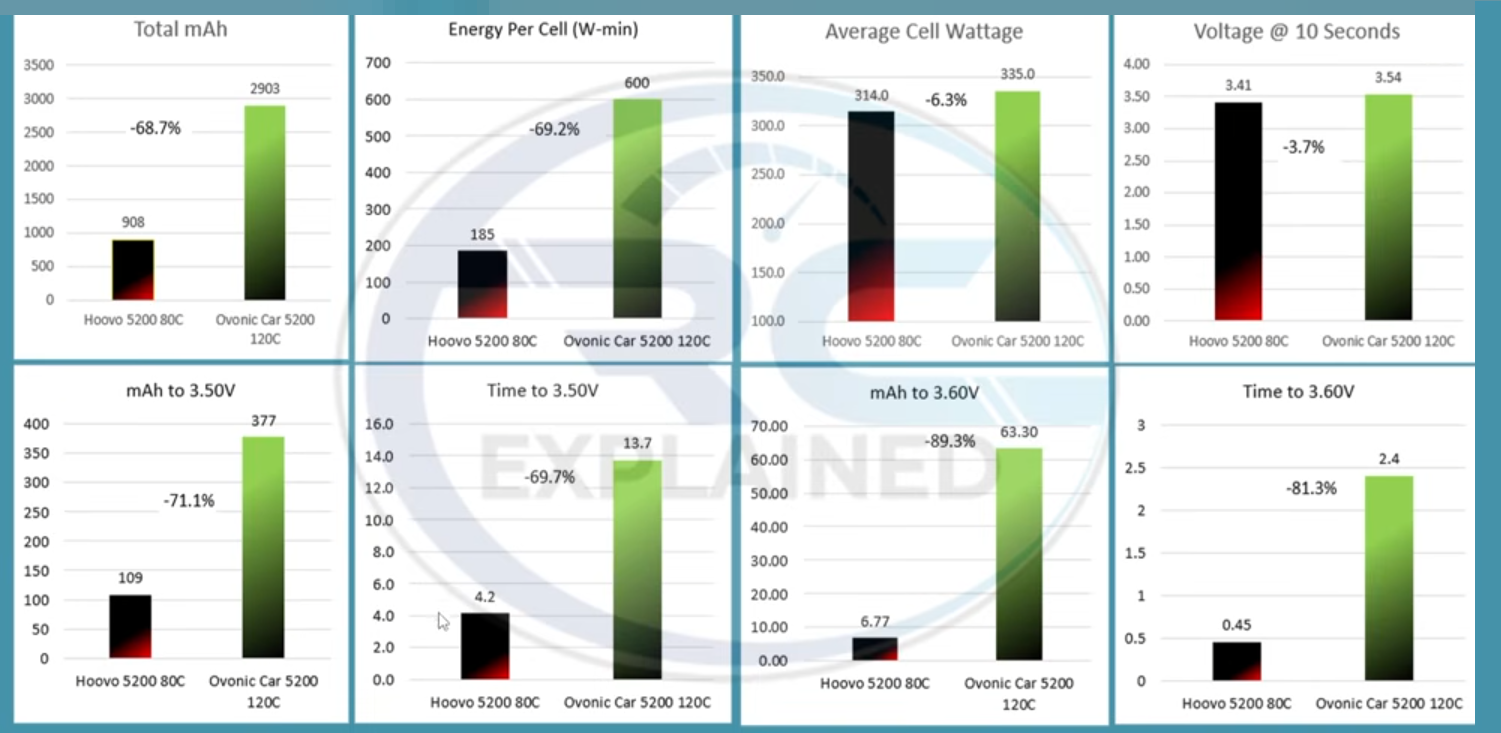
Overall, the results clearly favor the Ovonic.
For example, it maintains higher voltage under load, which directly improves usable capacity. In addition, it delivers significantly more runtime before reaching cutoff thresholds.
Meanwhile, the Hoovo drops voltage faster and reaches cutoff much earlier in the test cycle.
Practical Uses
In lighter RC setups, the Hoovo can still perform adequately. For instance, it works in bashing scenarios where current draw stays under roughly 80–90A.
However, once sustained load increases, performance drops off quickly due to voltage sag.
By comparison, the Ovonic handles high-current situations more effectively. Therefore, it is better suited for aggressive driving, speed runs, and longer sustained throttle use at 105A.
Final Thoughts
Overall, this Hoovo vs Ovonic a 100C 5200mAh Battle shows a clear performance gap.
On one hand, the Ovonic consistently delivers higher usable capacity and stronger voltage stability. On the other hand, the Hoovo struggles to maintain performance under sustained load despite its higher rating.
In conclusion, real-world performance strongly favors the Ovonic in this comparison.
Want the full data behind these battery tests? Join the RCexplained Battery Benchmark Squadron for access to detailed benchmark spreadsheets, internal resistance data, ranked battery comparisons, historical test data, plus the monthly RC Calculator spreadsheet and advanced data log analysis tools for Castle Creations ESC data used to generate the performance analysis and insights shared on this site. See membership options here.