
When shopping for RC LiPo batteries, one of the first specifications most people look at is the C rating. A higher number often suggests better performance, but in many cases, the number printed on the battery does not represent what the pack can actually deliver. Through testing dozens of LiPo batteries, I have found that the LiPo battery C rating printed on many packs can be significantly higher than the real-world performance.
For example, a 5200mAh battery rated at 110C would theoretically be capable of delivering over 570 amps continuously. However, performance testing shows that many batteries with these extremely high ratings cannot realistically sustain anywhere near those current levels. Instead, real-world performance is often determined by factors such as internal resistance, heat generation, and voltage retention.
What Does a LiPo Battery C Rating Actually Mean?
The C rating is intended to represent how much current a battery can safely deliver based on its capacity. To calculate the theoretical continuous current, you multiply the battery capacity by the C rating.
For example:
- 5000mAh battery = 5Ah
- 50C rating × 5Ah = 250 amps continuous
In theory, that means the battery should be capable of supplying 250 amps continuously. Additionally, many packs also include a burst C rating, which represents a higher current output for a short period of time.
However, the challenge is that there is no universal testing standard that every manufacturer follows when assigning these ratings. As a result, a battery labeled as 100C from one company may not perform the same as a 100C battery from another manufacturer.
Why Do Manufacturers Inflate C Ratings?
The simple answer is competition.
When consumers compare LiPo batteries, the C rating is one of the easiest specifications to understand. A battery labeled 120C appears better than one labeled 60C, even before looking at any other performance data.
Because of this, manufacturers are competing for attention by placing larger numbers on battery labels. A battery brand that accurately lists a lower C rating may appear weaker compared to competitors using much higher advertised numbers.
This creates a cycle where larger C ratings become a marketing advantage rather than a true measurement of performance.
As a result, many RC enthusiasts have learned to associate higher C ratings with better batteries, even though real-world testing does not always support that assumption.
Why C Ratings Can Vary Between Manufacturers
Another issue is that manufacturers may use different testing methods when determining their C ratings.
For example, one company may define continuous discharge as a short-duration load test where the battery only needs to survive for 20 or 30 seconds. Another manufacturer may use a different voltage cutoff or temperature limit when determining their rating.
Because the testing conditions are not standardized, the final number printed on the battery can vary significantly.
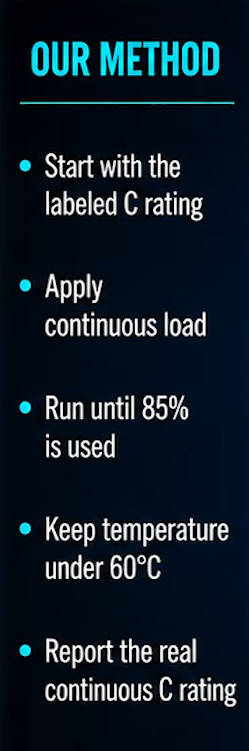
During my testing, I evaluate batteries differently. A continuous C rating should represent the amount of current a battery can sustain for the duration of the discharge while maintaining safe operating temperatures and usable performance.
Rather than focusing only on whether a battery survives a short burst, I look at how the pack performs throughout the entire test.
How Real-World Testing Reveals Battery Performance
Internal resistance is one of the most important indicators of actual battery performance.
A battery with lower internal resistance will experience less voltage sag under load. This allows the battery to maintain higher voltage, which results in more power being delivered to the motor.
On the other hand, a battery with higher internal resistance will lose more voltage during acceleration and heavy loads. This can reduce performance while also creating additional heat inside the pack.
Through testing, I have found that many 5000mAh LiPo packs with advertised ratings above 45C often perform much lower than the number printed on the label. The highest-performing packs I have tested typically fall somewhere around the 35C to 40C range based on real-world measurements.
At the other end of the spectrum, some lower-performing packs have tested closer to 12C.
This demonstrates that the label alone does not tell the complete story.
Why Real C Rating Matters for RC Performance
The actual performance of a LiPo battery affects much more than just the number printed on the label.
A battery with a realistic higher C rating will typically provide:
- Lower voltage sag under acceleration
- Higher power output
- Better motor performance
- Lower operating temperatures
- Longer battery lifespan
For RC vehicles, maintaining voltage under load is especially important. Higher voltage allows the motor to maintain higher RPM, which can translate into improved acceleration and higher top speeds.
However, a battery that produces excessive heat because it cannot handle the load will experience faster degradation over time.
Why A Higher Advertised C Rating Does Not Always Mean Better Performance
One surprising result from battery testing is that a higher advertised C rating does not always guarantee a better-performing pack.
In some cases, a battery labeled with a lower C rating has outperformed another battery from the same manufacturer with a much higher advertised rating.
This happens because the actual construction of the battery, cell quality, and internal resistance have a much greater impact on performance than the number printed on the label.
Therefore, when choosing an RC LiPo battery, it is better to look for proven performance data rather than simply selecting the pack with the highest C rating.
Final Thought
The LiPo battery C rating printed on a battery label can provide a general idea of where a pack is positioned, but it should not be considered a guaranteed measure of performance. As testing has shown, many advertised ratings are significantly higher than what the battery can realistically deliver.
Instead of choosing a battery based only on the biggest number on the label, look for real-world testing results that show internal resistance, usable capacity, voltage retention, and power output.
Actual performance data will always provide a better picture of what a LiPo battery can do.
Want the full data behind these battery tests? Join the RCexplained Battery Benchmark Squadron for access to detailed benchmark spreadsheets, internal resistance data, ranked battery comparisons, historical test data, plus the monthly RC Calculator spreadsheet and advanced data log analysis tools for Castle Creations ESCs used throughout this site. See membership options here.