
The GNB 110C vs Gens Ace G-Tech 60C comparison has been one of the most requested battery tests on the channel. Although the GNB is advertised with a much higher C rating, real-world performance can often tell a different story. In this test, I compared both 4S LiPo packs under the same 100A+ load to determine which battery delivers more usable capacity, better voltage retention, and higher sustained power.
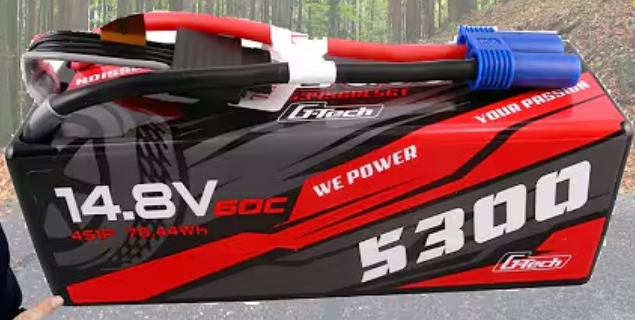
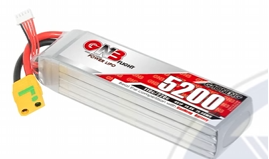
Battery Specifications
| Specification | GNB 110C | Gens Ace G-Tech 60C |
|---|---|---|
| Capacity | 5200mAh | 5300mAh |
| Cell Count | 4S | 4S |
| Advertised C Rating | 110C | 60C |
| Case | Soft Case | Hard Case |
| Test Connector | EC5 | EC5 |
Internal Resistance Results
Before running the discharge test, I measured the average internal resistance of each battery using the same testing procedure and environmental conditions.
| Battery | Average IR | Calculated C Rating | Estimated Continuous Current |
|---|---|---|---|
| Gens Ace G-Tech 60C | 2.53 mΩ | 21.6C | 114A |
| GNB 110C | 2.88 mΩ | 20.4C | 106A |
At this stage, the lower resistance of the Gens Ace suggested it should outperform the GNB despite carrying a lower advertised C rating.
Test Overview
Next, both batteries were tested using identical EC5 connectors and the same 100A+ discharge profile to ensure a fair comparison.
During testing, the GNB reached its temperature limit before all of its available capacity could be used. I stopped the discharge at approximately 58°C, and the battery continued climbing to roughly 61–62°C after the load was removed. Consequently, the measured capacity represents the battery’s usable output under heavy load rather than its full rated capacity.
Battery Comparison
Overall, the discharge results closely matched the predictions from the internal resistance measurements.
The Gens Ace delivered more usable capacity, produced more energy throughout the test, and maintained higher voltage under load for a longer period. Meanwhile, the GNB remained competitive during the early portion of the discharge, with both batteries showing nearly identical voltage at the 10-second mark.
| Metric | GNB 110C | Gens Ace G-Tech 60C | Winner |
|---|---|---|---|
| Usable Capacity | 4046mAh | 4557mAh | Gens Ace |
| Energy Per Cell | 837 Wh-min | 942 Wh-min | Gens Ace |
| Average Cell Power | 335W | 340W | Gens Ace |
| Voltage at 10 Seconds | 3.58V | 3.58V | Tie |
| Capacity to 3.5V | 847mAh | 1062mAh | Gens Ace |
| Time to 3.5V | 31s | 37.5s | Gens Ace |
| Capacity to 3.6V | 124mAh | 264mAh | Gens Ace |
| Time to 3.6V | 4.5s | 9s | Gens Ace |
What the Results Mean
The most significant difference between these batteries was the amount of usable capacity available during a high-current discharge. The Gens Ace delivered approximately 500mAh more usable capacity than the GNB, resulting in about an 11% improvement in runtime under load.
In addition, the Gens Ace generated more total energy while maintaining slightly higher average power throughout the test. Although both batteries experienced voltage sag, the Gens Ace held its voltage above the common 3.5V and 3.6V thresholds for considerably longer.
For everyday RC driving or bashing, the GNB still offers respectable performance and should satisfy many users. However, if you’re looking for maximum acceleration, higher top speeds, or the best overall high-load performance, the Gens Ace provides the stronger package.
One additional consideration is battery construction. I generally prefer soft-case LiPo packs because they allow battery temperatures to be monitored more accurately during operation. Nevertheless, both soft-case and hard-case batteries can perform well when used within their intended applications.
Final Thought
Overall, the GNB 110C vs Gens Ace G-Tech 60C comparison clearly favors the Gens Ace. Despite having a lower advertised 60C rating, it outperformed the GNB in seven of the eight measured categories while delivering more usable capacity, greater energy output, and better sustained performance under heavy load.
The GNB remains a capable battery for general RC use, especially if you’re primarily bashing. However, if performance is your top priority, the Gens Ace is the better choice based on these test results.
Want the full data behind these battery tests? Join the RCexplained Battery Benchmark Squadron for access to detailed benchmark spreadsheets, internal resistance data, ranked battery comparisons, historical test data, plus the monthly RC Calculator spreadsheet and advanced data log analysis tools for Castle Creations ESCs used throughout this site. See membership options here.