
When it comes to understanding LiPo battery performance, one of the most overlooked metrics is the real C rating—the true indicator of how much current a pack can deliver. Many hobbyists rely on the manufacturer’s labeled C rating, but as I’ve shown in past tests, those numbers often don’t reflect real-world performance. In this post, I’ll show you a quick and simple way to estimate your battery’s C rating using just a standard charger, thermometer and a calculator.
Why This Method Matters
This quick test is perfect for anyone new to RC battery analysis or those who haven’t yet explored real-world testing. Even if you don’t calculate the exact C rating, the method I’ll share helps you better understand your battery’s overall performance and how it changes over time.
For this demonstration, I used a 2200 mAh 2S LiPo—the same battery I use to power the ECU and fuel pump in a turbine powered RC jet, as well as a 22-inch RC boat I recently designed and 3D-printed.
Setting Up the Test
To start, I placed the battery on the charger and used a 1.5C charge rate—that’s 2.2 × 1.5 = 3.3 A. Keeping the test consistent is key, so I recommend monitoring room temperature with a thermometer and staying within one degree of previous tests. Even small temperature changes can affect internal resistance (IR) readings.
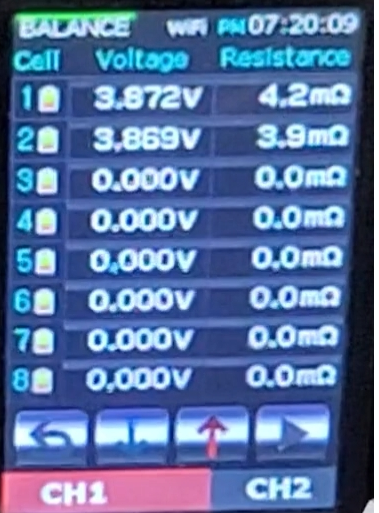
After about a minute, my charger displayed the internal resistance per cell. That one-minute mark is ideal for capturing accurate and repeatable measurements. If your charger takes readings at a different interval, note it down so you can stay consistent across future tests.
Calculating the Real C Rating
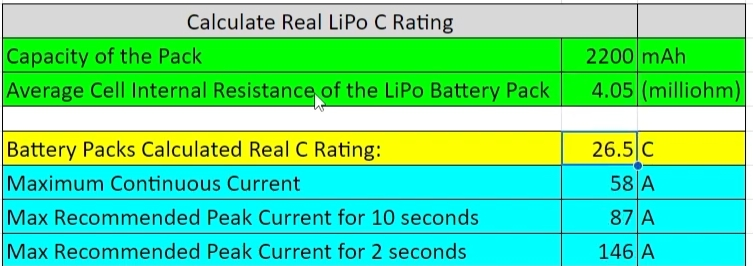
Next, I entered the IR readings into the RCexplained Calculator Sheet, which updates monthly for Patreon members. For this example, the two cells measured 4.2 mΩ and 3.9 mΩ, giving an average of 4.05 mΩ per cell.
After entering a 2200 mAh capacity and 4.05 mΩ average resistance, the calculator estimated a real C rating of about 26.5C for this pack. That means while the manufacturer’s label might suggest higher performance, the true continuous discharge capability is closer to 26.5 times its capacity in amps.
It’s a simple, effective way to see how your pack actually performs—no advanced equipment required.
Consistency and Long-Term Insights
Recording these results over time allows you to track how your batteries age. For example, by retesting after a year or two, you can see how internal resistance increases and performance declines. This helps determine when a pack has reached the end of its useful life and ensures you’re always using reliable batteries for your RC models.
Where to Access the Tools
If you become a Tier 2 RC Explained Patreon member, you’ll gain access to the full Battery Sheet, which includes all packs tested since 2023. This resource grows by at least one battery per month and provides detailed performance data to compare across brands and capacities.
You can also use a simplified version of the calculator on the website. While it doesn’t include all the advanced features, it still gives you a solid estimate of your battery’s real C rating.
Final Thoughts
Testing your LiPo batteries’ internal resistance is one of the quickest and most valuable checks you can perform. It’s consistent, repeatable, and tells you far more about performance than any label. It also offers you a way to compare battery performance over time.
Whether you’re flying jets, racing boats, or bashing trucks, knowing your battery’s true capability helps you get the most from your RC setup.