
Brushless motors are available with many different winding choices. These windings are critical to matching a motor to a specific application. However, have you ever wondered how two similar-sized brushless motors can produce comparable power even when their Kv values are very different?
Continuous Power Output Limitation
The first topic to understand is what truly limits the continuous power output of a brushless motor. The primary electrical limitation is heat. As discussed in another article, too much heat can permanently damage a brushless motor.
Brushless motors do not operate at 100% efficiency. If they did, nearly all of the electrical power entering the motor would be converted into useful mechanical power, and heat would be far less of a concern. In practice, a typical RC brushless motor may operate at approximately 80% to 90% efficiency near an appropriate operating point.
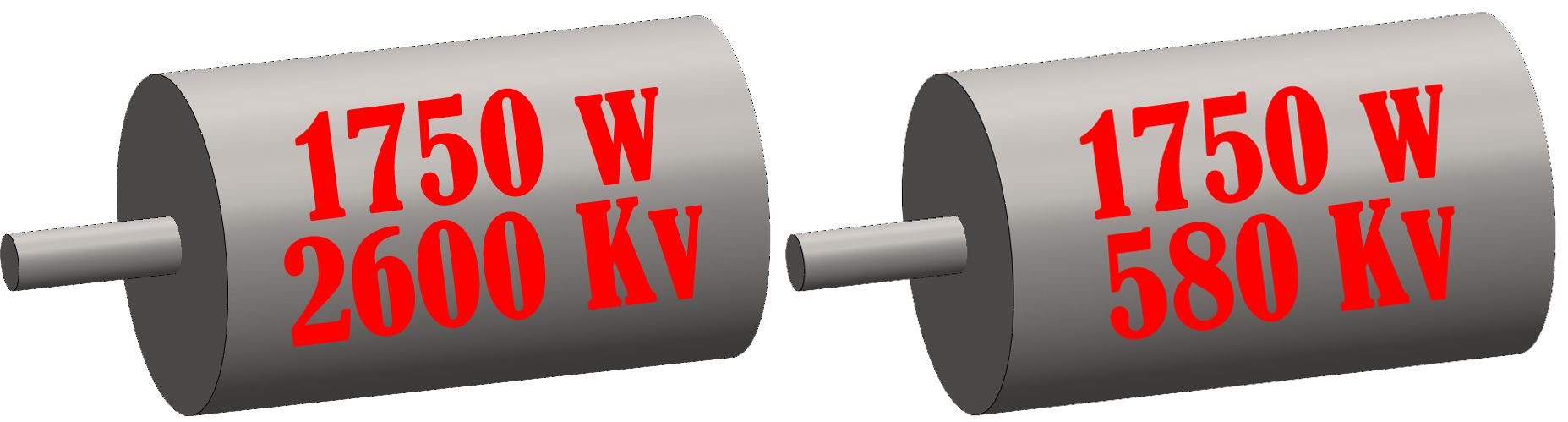
We are going to follow one example throughout this article. Consider a motor capable of continuously handling 1,750 watts. If we assume that the motor operates at 90% efficiency, approximately 10% of the input power will be converted into waste heat. That works out to roughly 175 watts of heat.
For comparison, an old-style 100-watt incandescent light bulb releases most of its input power as heat. Our motor must be able to continuously dissipate considerably more heat than that without exceeding a damaging temperature. If it cannot remove that heat effectively, it should not be rated to produce 1,750 watts continuously under those conditions.
A larger motor can generally absorb and dissipate more waste heat. With an inrunner motor, heat can leave through the motor case and then transfer into the surrounding air, motor mount or cooling system. Increasing the motor’s size, surface area and thermal mass can allow it to handle more waste heat and therefore produce more continuous power.
How Brushless Motors Produce Waste Heat
A major source of heat inside a brushless motor is current flowing through the resistance of its windings. This is commonly referred to as copper loss and is calculated using current squared multiplied by winding resistance. Voltage does not directly create copper loss by itself, although voltage affects motor speed and can influence other losses within the motor.
If higher current creates substantially more copper loss, how can a high-Kv motor operating at high current produce power comparable to a low-Kv motor operating at much lower current? It may seem that the higher-current motor should always create far more waste heat.
The answer can be seen in the data below. Motor 1 is shown in the first row, while Motor 2 is shown in the second row.
| Continuous Wattage | Kv Value | Voltage | Current | Rm | Io |
|---|---|---|---|---|---|
| 1,750 W | 2,600 RPM/V | 11.1 V | 158 A | 0.0047 ohm | 5.83 A |
| 1,750 W | 580 RPM/V | 44.4 V | 40 A | 0.0831 ohm | 0.92 A |
Waste Heat Produced by Each Brushless Motor
We know that waste heat is one of the primary limitations on continuous motor power. To understand how these two motors can produce similar amounts of waste heat, we can use the data above. Two important categories of motor loss are copper losses and iron-related losses.
Copper loss occurs in the motor windings and is calculated by squaring the current and multiplying it by the winding resistance. For this simplified comparison, the estimated no-load or iron-related loss is calculated by multiplying the test voltage by the no-load current.
| Motor | Copper Losses | Estimated Iron and No-Load Losses | Total Estimated Losses |
|---|---|---|---|
| Motor 1 — 2,600 Kv | 117 watts | 65 watts | 182 watts |
| Motor 2 — 580 Kv | 133 watts | 41 watts | 174 watts |
As we can see, both motors produce a similar amount of estimated waste heat. These values also closely match the approximately 175 watts of heat predicted by assuming 90% efficiency at 1,750 watts of input power.
The important point is not that every motor will produce numbers this close. Real results depend on motor construction, operating speed, cooling, controller timing, load and the accuracy of the motor data. The example demonstrates how motors with very different Kv values can still have similar power and thermal limitations.
Conclusion
Within a similar motor family, a lower-Kv winding generally uses more turns of wire and has higher winding resistance. It can operate at higher voltage and lower current. A higher-Kv winding generally has lower resistance but requires much more current to produce the same input power.
Because copper loss is based on current squared multiplied by resistance, the high current of the high-Kv motor is partly offset by its very low winding resistance. The lower-Kv motor draws less current, but its higher winding resistance still produces a meaningful amount of heat. No-load and iron-related losses also contribute to the final result.
This is why two similarly sized brushless motors with very different Kv values can have similar continuous power ratings. Their voltage and current requirements may be very different, but their total waste heat—and their ability to remove that heat—can be surprisingly similar.