
I’ve spent about a week testing the GT Power C6D Pro, an entry-level smart charger for radio-controlled batteries. I’ve charged everything from two-cell LiPo packs up to six-cell LiPo packs, along with NiMH, NiCd, and LiFe chemistries. In this review, I’ll break down the specifications, features, quirks, and my experience using it in real-world scenarios.
Specifications
The C6D Pro supports both AC and DC input. AC input ranges from 100 to 240 volts, while DC input covers 11 to 26 volts, letting you use everything from a 12V car battery to a 24V power supply. On DC, it delivers up to 300 watts, while AC is limited to 100 watts. This is enough to charge a six-cell LiPo pack at just over 4 amps, which is solid for fast charging larger packs.
Charge current ranges from 0.1 to 12 amps, and the balance current reaches 1 amp. Discharge power is limited to 5 watts, but there’s a special FB-DI mode where you can recycle power: the charger takes energy from one battery and discharges it into another pack at up to 300 watts.
It can handle:
- LiPo: 1–6 cells
- NiMH/NiCd: 1–15 cells
- Lead-acid: 2–12 volts (up to 20V depending on cell count)
I did not test lead-acid batteries, but I did charge various LiPo and NiMH packs successfully.
Charging and Functionality
Powering the unit up shows the LiPo battery mode by default. You can choose different functions: charge, storage, repair, balance, and discharge.
For charging a six-cell LiPo at 5 amps (1C), the charger does a battery check, confirms the series count, and then ramps up the current. I noticed a small pause early in the charge cycle before reaching the full 5 amps, but it continued smoothly afterward. You can monitor voltage, mAh added, and individual cell voltages in real-time.
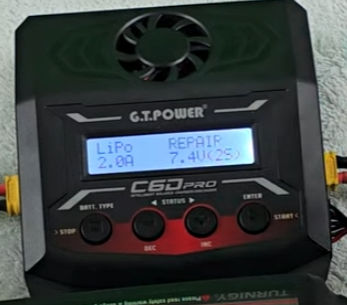
The storage mode sets packs to 3.85 volts per cell for safe long-term storage. The repair function can revive low cells, and balance mode evens out cell voltages. Discharge mode is limited to 5 watts without an external battery, but using the FB-DI mode allows high-power energy transfer between packs.
Extended Functions
The charger also has advanced features:
- Brushed motor testing with voltage/current limits
- Constant current/constant voltage power supply mode (CCCV)
- PWM in/out testing for servos
- User program saving and loading for specific battery packs
For internal resistance measurements, you need to activate the specific function; it doesn’t run automatically during charging. It provides cell-by-cell milliohm readings, which is useful for comparing packs or diagnosing weak cells.
Quirks and Observations
One quirk I noticed is that the charger’s specified charge current reflects the input current rather than the actual current delivered to the battery pack. While there’s only a small difference, it’s an unusual approach compared to most chargers.
Another minor quirk is the brief pause at the start of the charge cycle before the current ramps up. It doesn’t affect performance, but it’s something I observed consistently.
Final Thoughts
The GT Power C6D Pro is a solid entry-level smart charger with an impressive range of functionality, from standard charging to power recycling, storage, repair, and advanced user programs. Its dual AC/DC input and support for multiple chemistries make it versatile, and I found it reliable for LiPo and NiMH packs.
Want to analyze your own setup beyond what’s covered in this post? Join RCexplained Insights Access for advanced data log analysis tools for Castle Creations ESCs, the monthly RC Calculator spreadsheet, searchable public data logs, and member resources built to help you tune, compare and improve performance. View membership plans here.