When it comes to brushless motor specs, few values are as misunderstood as RC motor Kv. Many hobbyists know it’s an important number printed on every motor, but not everyone understands what it actually represents—or what it doesn’t.
The Kv rating tells us how many revolutions per minute (RPM) a motor will produce per volt applied with no load. For example, a 2200 Kv motor theoretically spins at 2200 RPM for every volt supplied. However, this value only describes the motor’s velocity constant—not its total torque output, efficiency, or total power. If you are more advanced on this subject, don’t confuse Kv with Ke. (back-EMF constant)
What Kv Really Represents
The Kv value is measured using back electromotive force (back EMF) rather than directly applying voltage and measuring RPM. It defines how fast a motor will spin for each volt applied, assuming no mechanical load.
If you take the reciprocal of Kv (1 / Kv), you get another constant known as Kt, the torque constant. While Kv describes speed per volt, Kt describes torque per amp. This means Kv and Kt are linked: a higher Kv motor spins faster per volt, while a higher Kt motor produces more torque per amp.
The relationship between Kv and Kt explains how speed and torque balance within a brushless motor. The chart below summarizes what each constant represents and how they relate to each other.
Do note that when using Kv in any calculation, you must use Kv in SI units. This means converting RPM to Rad/s. To do this multiply RPM by 0.10467. This number comes from the conversion factor of 2 x Pi / 60.
| Term | Definition | Units | Describes | Relationship |
|---|---|---|---|---|
| Kv (Velocity Constant) | The number of revolutions per minute (RPM) a motor produces per volt applied with no load. | RPM/V | Motor speed per volt | Higher Kv = higher speed, lower torque per amp |
| Kt (Torque Constant) | The amount of torque a motor produces per amp of current. | Nm/A (or oz·in/A) | Motor torque per amp | Kt = 1 / Kv (in consistent units) |
Comparing Motors by Kv
At first glance, you might assume the 800 Kv motor produces more torque because it’s Kv is lower. But torque output depends on current, not Kv alone. To find actual torque, you must multiply the Kt constant by the current (in amps) being applied.
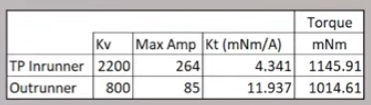
This means that Kv doesn’t tell you total torque—only how much torque per amp the motor can generate. Similarly, Kv doesn’t reveal power output or efficiency. Two motors with different Kv ratings can have the same torque potential if their current and voltage ratings align.
What Kv Doesn’t Tell You
The RC motor Kv rating does not indicate:
- How much torque the motor produces in total
- The motor’s power output
- The efficiency of the system under load
Kv’s purpose is to help estimate motor speed based on Voltage you plan to apply. Once you know your voltage, you can select the correct Kv motor to optimize your power system.
For example, using a higher Kv motor on too high a voltage can overspin the motor, leading to failure. Conversely, too low a Kv may limit top speed and power output.
Applying Kv in Real Builds
In RC applications, Kv helps you match voltage to speed:
- A higher Kv motor spins faster per volt but would operate on a lower total voltage consuming a higher total current..
- A lower Kv motor spins slower per volt but provides more torque per amp. It will run on a higher voltage but lower current.
Overall power output and efficiency is approximately equal. Take a look at this article on a Low vs High Kv Dyno Test to see how this works out.
Remember that Kv represents unloaded RPM—real-world performance will always be lower due to mechanical and electrical losses. Tools such as the calculator found on the RC Explained Patreon website can help predict loaded RPM and top speed more accurately.
Final Thoughts
Understanding RC motor Kv is essential for choosing the right motor for your voltage, gearing, and performance goals. It’s not a measure of torque or power—but when used correctly, it’s a powerful indicator of how your brushless setup will behave.