RC Gas Powered Boats
Gas-powered radio-controlled boats continue to grow in popularity, especially among hobbyists who enjoy larger, more powerful models. The category originally gained traction when hobbyists began modifying common trimmer-style (“weed eater”) engines to work in RC hulls. As interest increased, manufacturers began offering fully converted marine versions, and eventually purpose-built gas engines designed specifically for RC boating.

Today, RC gas boats are generally among the largest models in the hobby. Most hulls exceed 1 meter (40 inches) in length, offering impressive stability, presence on the water, and the ability to handle higher power levels.
Compared to nitro engines, gas engines are simpler to start, easier to tune, and more forgiving overall—qualities that make them especially attractive to new and experienced boaters alike. While their larger size and components can make them more expensive, many consider the added performance, scale, and reliability
Gas Boat Engines
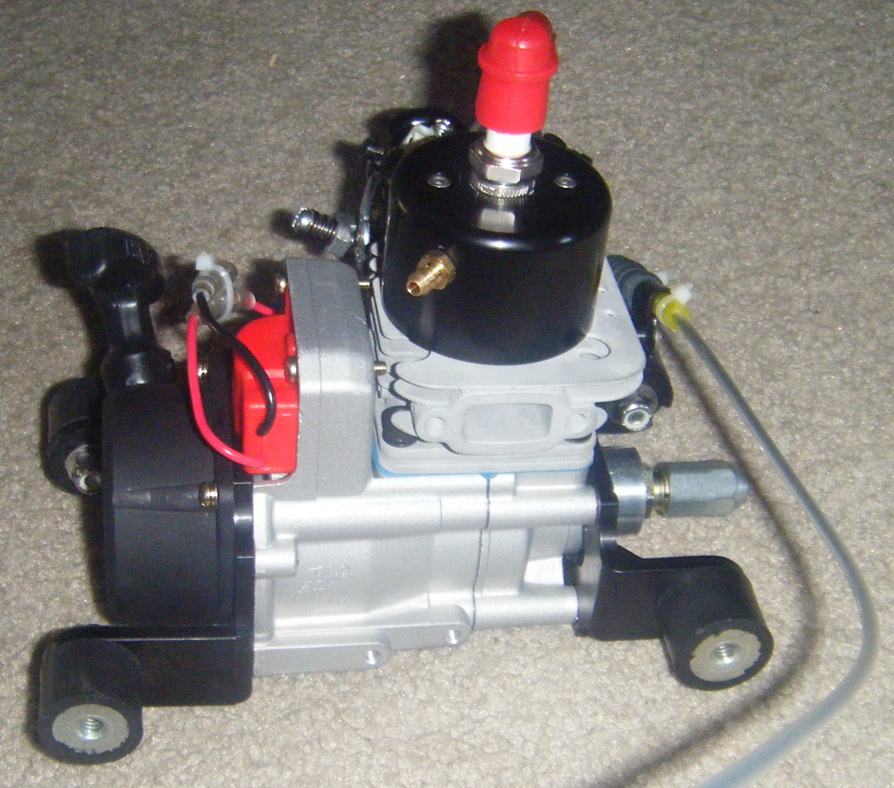
Gas engines are the core of large, high-power RC boat hulls. Even in stock form, most marine gas engines produce over 2 horsepower, while fully modified versions can exceed 5 horsepower. Although only a handful of engine platforms exist, many can be purchased in various modification stages from numerous engine builders.
Choosing the Right Engine
Beginners
If you’re new to gas boats, a stock Zenoah marine engine is the most reliable and user-friendly choice. These engines offer excellent performance, easy starting, predictable tuning, and long service life.
Experienced Boaters
Veteran gas boaters can choose from:
- Stock
- Mid-Modified
- Fully Modified
Each modification level increases RPM and horsepower, resulting in higher speeds—though tuning requirements and maintenance typically increase as well.
Expected Performance (Zenoah G26 Marine)
Speed varies by hull design, propeller choice, setup, and modification quality. These values are approximate.
Mono & Cat Hulls
| Engine Version | Approx. Speed (km/h) | Approx. Speed (mph) |
|---|---|---|
| Stock G26 | 50–60 km/h | 35–40 mph |
| Mid-Modified | ~80 km/h | ~50 mph |
| Full Modified | ~100 km/h | ~60 mph |
Hydro Hulls
| Engine Version | Approx. Speed (km/h) | Approx. Speed (mph) |
|---|---|---|
| Stock G26 | ~80 km/h | ~50 mph |
| Mid-Modified | ~96 km/h | ~60 mph |
| Full Modified | ~112 km/h | ~70 mph |
Engine Mounting (Zenoah Marine)
Most gas hulls are built with 125 mm (5″) stringer spacing, the standard width for Zenoah-style marine mounts. Engine mounts designed for these engines commonly include rubber isolators to reduce vibration and protect the hull.
Before purchasing a mount, always confirm:
- Your hull’s stringer spacing
- Compatibility with your specific Zenoah-based engine
Gas Boat Engine Tuning
1. Key Tuning Terms
| Term | Meaning | Adjustment |
|---|---|---|
| Rich | Fuel mixture contains too much fuel | Turn needle counter-clockwise to richen |
| Lean | Fuel mixture contains too little fuel | Turn needle clockwise to lean |
Maintaining the correct mixture is critical for performance and engine life. Running too lean can cause overheating and damage, while excessively rich settings reduce power and throttle response.
2. Engine Break-In Procedure
Always use the oil type and mix ratio recommended by your engine manufacturer.
Each tank = approx. 10–15 minutes of run time.
| Tanks | Throttle Use | Mixture | Notes |
|---|---|---|---|
| 1–2 | Up to ½ throttle, vary RPM | Slightly rich | Do not exceed half throttle. Keep RPM changing. |
| 3–4 | Vary throttle, occasional WOT bursts | Gradually lean toward good performance | Begin brief high-RPM runs. |
| 5–6 | Higher sustained RPM | Normal operating mixture | Increase duration of high-speed running. By the end of tank 6, begin running normally. |
After tank 6, the break-in process is complete and full-power tuning can begin.
3. Carburetor Needles on Gas Engines
| Needle | Description | Controls |
|---|---|---|
| High-Speed Needle (HSN) | Tallest needle on the carburetor | Fuel mixture at high RPM / WOT |
| Low-Speed Needle (LSN) | Typically located 90° off the venturi | Fuel mixture at low RPM / idle / slow speeds |
Note: Adjusting the HSN also influences the LSN, so tuning always begins with the High-Speed Needle.
4. Tuning Procedure
Step 1 — High-Speed Needle (HSN)
- Start and warm up the engine.
- Make several wide-open throttle passes.
- Listen carefully:
| Sound / Behavior | Condition | Adjustment |
|---|---|---|
| Bogging, hesitation, weak top end | Lean | Richen HSN (CCW) |
| Gurgling, sputtering, excessive smoke | Rich | Lean HSN (CW) |
General guidelines:
- Make small adjustments (⅛ turn maximum).
- If unsure, start by richening—it is safer.
- Return to the previous known-good setting if performance worsens.
- A properly tuned engine will sound clean, powerful, and crisp.
Step 2 — Low-Speed Needle (LSN)
Adjust only after the HSN is correctly tuned.
Slow-Speed Behavior Check
Run the boat at its slowest stable speed:
| Behavior | Condition | Adjustment |
|---|---|---|
| Bogging, gurgling, heavy smoke | Rich | Lean LSN (CW) |
| RPM slowly rises without throttle input | Lean | Richen LSN (CCW) |
Acceleration Test
- Let the boat run at slow speed for 10–20 seconds.
- Punch the throttle.
| Result | Meaning | Correction |
|---|---|---|
| Engine stalls or flames out | Mixture incorrect | Adjust LSN based on rich or lean behavior |
| Slow response + heavy smoke | Rich LSN | Lean slightly |
| Sharp stumble, then recovery | Lean LSN | Richen slightly |
Fine-tune until throttle response is smooth and immediate.
Gas Boat Fuel
Gas-powered RC boats use the same base gasoline as automotive fuel—the difference is the two-stroke oil mixed into it. Proper octane selection and the correct oil ratio are essential for engine life and performance.
1. Fuel Octane Requirements
| Engine Type | Recommended Octane | Notes |
|---|---|---|
| Stock Gas Engines | 87 Octane (regular unleaded) | Safe for most factory Zenoah-style engines. |
| Modified Engines | 91 Octane+ (premium) | Higher compression and timing changes may require higher octane. |
If unsure which octane is suitable, always refer to the engine manufacturer’s manual.
2. Required Two-Stroke Oil
A quality two-stroke oil must be mixed into the gasoline.
- Synthetic or synthetic-blend oils are recommended but not strictly required.
- Designed for air-cooled two-stroke engines (not marine outboard oil).
3. Fuel-to-Oil Mix Ratio
Most RC gas boat engines run mixtures in the range of:
| Fuel-to-Oil Ratio | Typical Use |
|---|---|
| 15:1 – 20:1 | Early break-in, high-performance modified engines |
| 25:1 – 30:1 | Common for most stock and mid-mod engines |
| 30:1 – 35:1 | Light operation or specific manufacturer recommendations |
Always follow the manufacturer’s specific ratio—improper oil content can reduce performance or cause engine damage.
4. Measuring the Correct Oil Amount
Use the RC Fuel Calculator to determine exactly how much oil to add for the amount of gasoline you purchased.
Example:
| Fuel Volume | Ratio | Oil Required |
|---|---|---|
| 1 Liter | 25:1 | 40 ml |
| 1 US Gallon | 32:1 | 4 oz |
| 5 Liters | 30:1 | 167 ml |
Gas Boat Propeller
Choosing the correct propeller is one of the most important tuning steps for a gas-powered RC boat. The prop converts engine power into forward thrust, and the only true way to find the optimal prop is testing and comparing multiple options.
Use the Propeller Database to filter by size, pitch, brand, or hull type.
1. Recommended Starting Props (By Brand)
These are common starting points that typically get a gas hull on plane for initial testing.
| Brand | Suggested Starting Props |
|---|---|
| ABC | 2514, 2516, 2614, 2616 |
| Octura | X467, X470, X470/3, X670, X472 |
| Prather | S270, S275 |
| Propshop / Voodoo | 6516/3, 6717/3, 7016/3 |
These are baseline recommendations—testing and recording GPS data is the only reliable way to determine the best setup.
2. 2-Blade vs. 3-Blade Propellers
When diameter and pitch are equal, these characteristics generally apply:
| Prop Type | Advantages |
|---|---|
| 2-Blade | • Higher top speed • Less load on the engine • Higher achievable RPM |
| 3-Blade | • More thrust (better acceleration) • Improved cornering stability • Higher lift characteristics |
Note: These are general tendencies; each hull reacts differently.
3. Octura Propeller Series Guide
A simplified overview of common Octura propeller families—useful when choosing which series to test.
| Series | Characteristics / Typical Use |
|---|---|
| 12 | Low pitch, large diameter; ideal for submerged drives |
| X4 | Low-lift, general-purpose props |
| M4 | Similar to X4 but de-tongued to reduce load |
| Y | X-series style with ~10% more pitch |
| X5 | Medium lift & higher pitch; more aggressive than X4 |
| X6 | Medium–high lift; higher load |
| 14 | Medium–high lift; common for hydroplanes |
| 16 | High-lift props for hydros and riggers |
| 17 | Very high lift; typically for riggers/hydros |
| P7 | Similar to 17 but with more rake and slightly less lift |
| 19 | High lift; suited for fast hydros/riggers |
| V9 | Moderate lift, high pitch; strong SAW choice |
| 20 | High pitch, moderately high lift; riggers/hydros |
| 21 | High lift; hydro/rigger oriented |
| 22 | Highest pitch; surface drive only, straight-line speed |
RC Gas Boat Tuned Pipe
Introduction
A tuned pipe is one of the most effective performance upgrades for a gas-powered 2-stroke RC boat. Its purpose is to increase power at higher RPM, which translates directly into higher top speed. Proper setup is essential—an incorrectly tuned pipe will not deliver its intended performance.
How a Gas Boat Tuned Pipe Works
A tuned pipe essentially functions as two cones joined end-to-end:
- Diverging cone – gradually increases in diameter
- Converging cone – gradually decreases in diameter
When exhaust gases leave the engine and enter the tuned pipe:
- The pressure wave moves through the expanding cone.
- When it reaches the decreasing cone, the shape reflects the pressure wave back toward the engine.
- This returning wave pushes the unburned fuel/air mixture that escaped into the header back into the combustion chamber.
The result is:
- More available fuel inside the cylinder
- Increased combustion efficiency
- Higher RPM and more power at the top end
This is why tuned pipes are so effective for 2-stroke engines.
Installing and Setting a Tuned Pipe
A tuned pipe is not a simple bolt-on component—it must be adjusted to the correct length to match your engine’s RPM range.
Measuring Tuned Pipe Length
Measure from:
- The engine’s exhaust flange
to - The widest point of the tuned pipe (where the two cones meet)
or, for a band pipe, where the rear cone begins to taper
This total measurement is critical to tuning.
Starting Length (Zenoah 25cc and Similar Engines)
A good baseline length is:
320 mm (12-5/8″) or longer
Once set:
- Warm up the engine.
- Run the boat at full throttle.
- Record the speed (a GPS is ideal).
- Bring the boat in and shorten the pipe by 3–6 mm (1/8″–1/4″).
- Repeat test runs after each adjustment.
- Stop shortening when performance begins to drop off.
You may notice the loss of performance as:
- Lower top speed
- Weaker acceleration
- Poor cornering power
Choose the pipe length that provides the best overall performance for your driving style and hull type.
Tuned Pipe Tips
- Different props and hardware setups can slightly change the pipe’s tune point.
- It’s best to select a stable, well-performing prop before tuning the pipe.
- Expect the characteristics of the hull to change after the pipe is optimized.