
I’m sharing a tip that could save you hundreds of dollars in totaled RC Airplanes. It’s simple, quick, and inexpensive to execute.
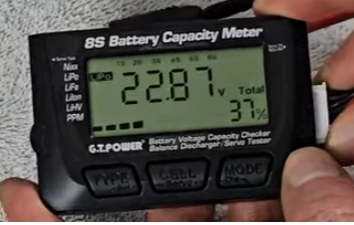
One of the most important things when flying an RC airplane is making sure your battery pack is fully charged. The question is: how do you know if it really is? For lithium-based batteries, it’s easy. I use an RC battery capacity meter that plugs into the balance lead of the pack. It gives me a voltage readout for each cell and often shows the total capacity as a percentage. This lets me quickly check if the battery is ready to go.
At the flying field, I’ve seen planes with supposedly charged batteries that weren’t fully charged. This is especially dangerous with electric ducted fan jets, which use a lot of power. Using a meter like this avoids putting a partially charged battery into a plane, preventing potential crashes and costly repairs.
The GT Power 8S battery capacity meter I use has a few standout features. Not only does it display cell voltage and capacity, it can discharge cells that are too high and even function as a servo tester. I can plug in a battery, check each cell, balance them if necessary, and set a minimum voltage for safe operation.
I also use it to test servos. The meter allows me to sweep a servo across its range, identify exact positions, and adjust midpoints. This functionality ensures that both my batteries and servos are performing correctly before flight.
Using a tool like this is fast and inexpensive. Plug in your battery, check the readings, and make sure your pack is near 100% capacity. Doing this consistently can save you hundreds of dollars in replacement batteries and repairs.