
I recently got my hands on the GT Power V6 Pro, and I have to say, this charger is packed with power and unique features that I’ve never seen in a charger before. In this review, I’ll walk you through its specifications, functionality, quirks, and my hands-on experience.
Specifications
The V6 Pro supports AC input from 100–240 volts and DC input from 7–30 volts, giving you flexibility in your power source. On AC, it can deliver up to 200 watts. On DC, at 16 volts, it can reach a maximum of 700 watts, enough to charge two 6S batteries at 16 amps each—essentially a 3C charge for a 5000 mAh pack. The maximum input current is 32 amps, which translates to 16 amps per channel.
It has two independent channels, allowing simultaneous charging of separate batteries. Charge current ranges from 0.1 to 16 amps per channel, while discharge current ranges from 0.1 to 3 amps per channel. The balance current peaks at 1.8 amps, which is impressive compared to most chargers that max out at around 1 amp. However, they don’t really describe if this 1.8A can be 1 of 6 cells or if its the total of all 5 of 6 cells.
The charger can detect 1–16 NiMH/NiCd cells, 1–6 LiPo/LiFe/Li-ion cells, and 2–24V lead-acid batteries. It also features a wireless charging pad on top for phones, delivering up to 7.5 watts. This is handy if you need to top up your cell phone but also not what everyone will be looking for in an RC battery charger.
Setting Up and Charging
Plugging in the AC power immediately powers the unit. I tried the wireless phone charging, and it worked right away—definitely a convenient bonus but not something I necessarily need.
On the main screen, I selected channel one for a LiPo battery. I could choose from charge, balance, fast charge, discharge, storage, and repair. For charging, I set the voltage to 4.2V and the current to 5 amps (1C). The charger ramped up quickly, and I could see wattage, temperature, and cell voltages in real-time. The internal resistance readouts ranged from 4.7 to 6.3 milliohms, giving me useful insight into the battery’s condition.
For channel two, I tried storage mode with a 3S 2200 mAh battery. The charger recommended 3.8–3.85V per cell. I set it to 3.85V, and the sequence completed quickly. Internal resistance values were recorded even in storage mode, which was interesting.
Advanced Functionality
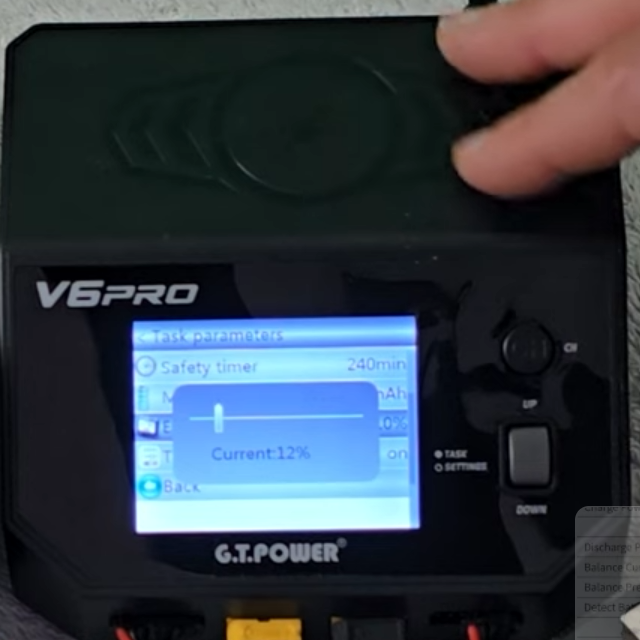
I was particularly impressed by the ability to adjust the end-of-charge current. This allows advanced users to speed up charging by stopping the constant voltage phase early. The charger also has configurable safety timers, maximum capacities, and trickle charge settings.
System settings let me adjust language, input voltage limits, LCD brightness, beep sounds, and even the device name.
Quirks
I did notice some quirks. The AC power generates a noticeable electrical buzzing, similar to inexpensive PC power supplies. The discharge power per channel was lower than specified—5 watts instead of 15 watts. Additionally, the DC input wattage claims in the manual are confusing; the 700W maximum requires 21.88 volts, not 16 volts as the manual suggests. The maximum 32A input current multiplied by the 16V to achieve Max power, provides only 512Amps.
Final Thoughts
The GT Power V6 Pro is a powerful, feature-rich charger with dual-channel capability, advanced settings, and unique features like wireless phone charging and internal resistance readouts. The quirks are minor compared to the functionality it provides. I’m looking forward to comparing its internal resistance readings with other chargers in future tests.