
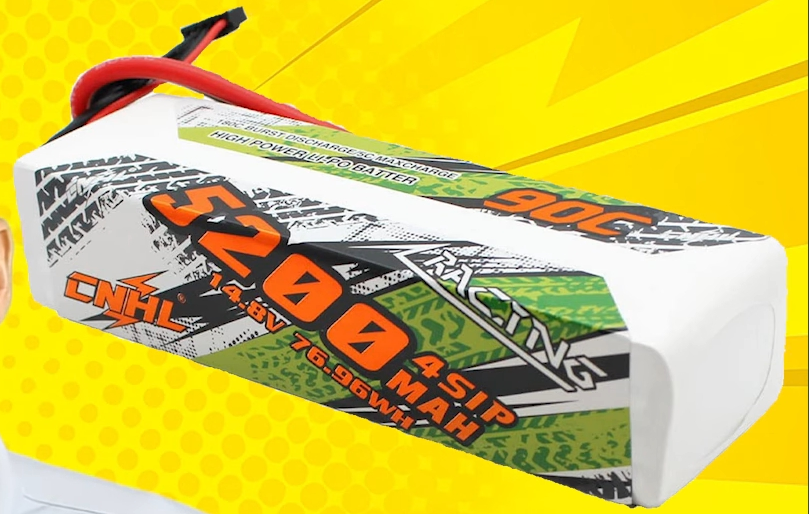
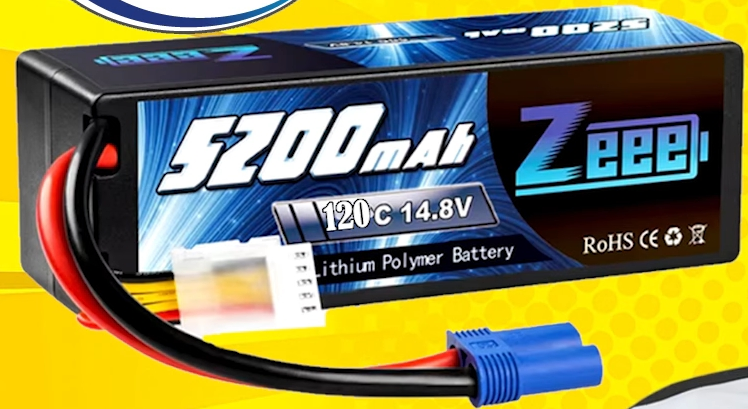
I test the CNHL vs Zeee LiPo by running two competitively priced 5200mAh 4S packs under identical conditions. The batteries are the CNHL 5200mAh 4S 90C and the Zeee 5200mAh 4S 120C. While they share the same capacity, their real-world performance shows very clear differences.
I fully balance both batteries and run them on the same equipment with the same ambient temperature. I record voltage sag, internal resistance, and discharge curves to ensure an accurate comparison.
Price Comparison
Both packs cost roughly the same, so price alone does not decide which one to buy. They are approximately $ 45 USD each.
Test Setup
Each pack was tested under the same conditions. A constant current load around 105 amps, a cutoff voltage at 3.3 V per cell. The measurements taken at max current, 10 seconds, 30 seconds, and cutoff. I focused on wattage, current, voltage, and usable capacity under these conditions.
I monitor heat buildup and voltage sag, which indicate inefficiency. Both batteries list 5200mAh, but usable capacity under heavy load shows the real difference.
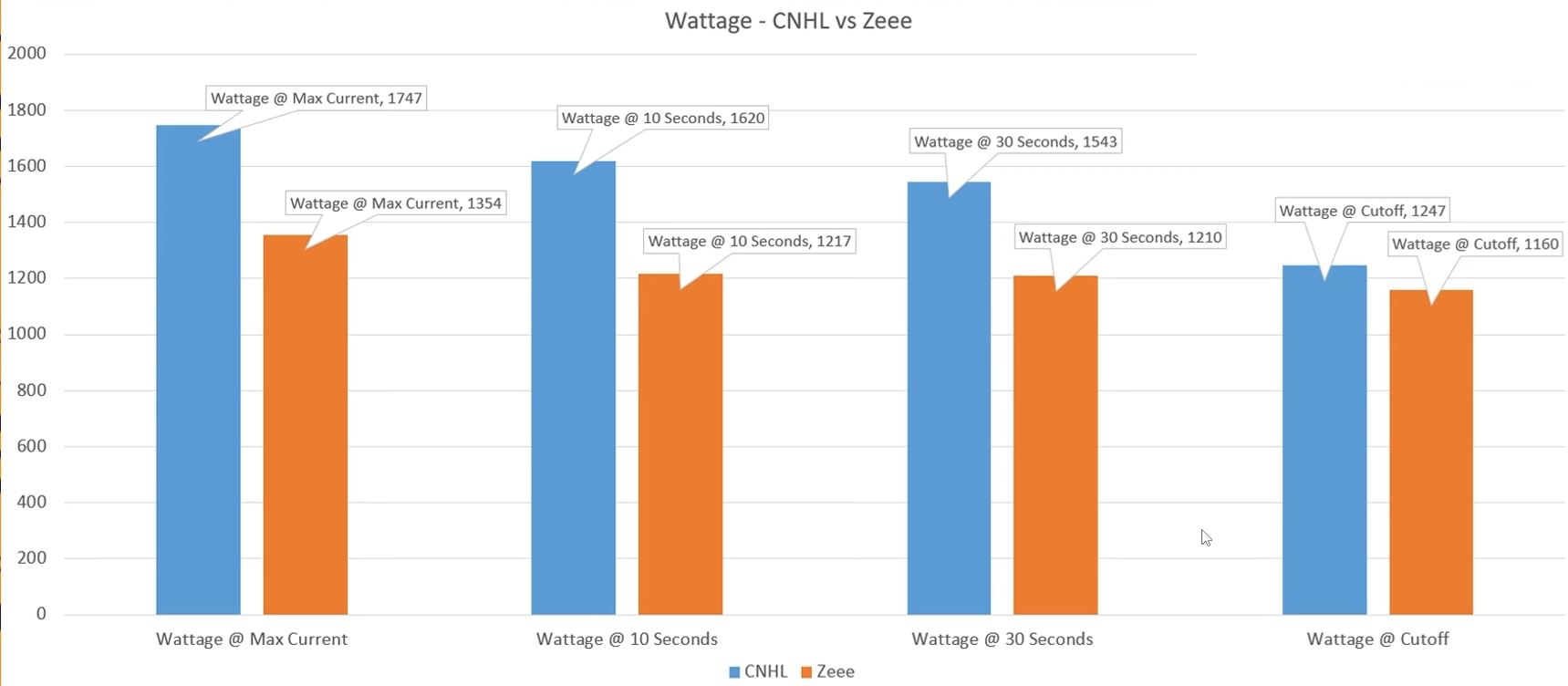
Wattage Output Over Time
| Test Point | CNHL (W) | Zeee (W) |
|---|---|---|
| Max Current | 1747 | 1354 |
| 10 Seconds | 1620 | 1217 |
| 30 Seconds | 1543 | 1210 |
| Cutoff | 1247 | 1160 |
The CNHL maintains higher power throughout the run. The Zee drops off quickly after just a few seconds. At full throttle, the CNHL delivers roughly 23% more power.
Voltage and Current Comparison
| Test Point | CNHL Current (A) | Zeee Current (A) | CNHL Voltage (V) | Zeee Voltage (V) |
|---|---|---|---|---|
| Max | 116.1 | 96.6 | 15.1 | 14.01 |
| 10 s | 110.0 | 90.7 | 14.8 | 13.41 |
| 30 s | 108.0 | 89.2 | 14.3 | 13.56 |
| Cutoff | 95.1 | 88.5 | 13.1 | 13.11 |
The CNHL holds voltage well under high load, allowing consistent current and steady wattage. The Zee struggles to maintain both current and voltage, resulting in roughly 25% lower power by 30 seconds.
Usable Capacity Under Load
| Load | CNHL Usable Capacity (mAh) | Zeee Usable Capacity (mAh) |
|---|---|---|
| 105A | 4693 | 872 |
| 80A | 4693+ | 2860 |
| 70A | 4693+ | 3701 |
| 65A | 4693+ | 4037 |
| 60A | 4693+ | 4279 |
The CNHL delivers 4693mAh before cutoff at 105A, nearly its full rated capacity. The Zee hits thermal limits and shuts down at 872mAh under the same load. Do note, under lower currents the CNHL battery would deliver more useable capacity, however, this was not directly tested for.
Thermal Performance and Real C Rating
The Zeee’s labeled 120C rating does not match its performance; it performs closer to 12C in real-world use. The CNHL stays within safe temperatures at 105A. This shows why testing real output matters more than trusting printed C-ratings on labels.
Summary Table
| Metric | CNHL 5200mAh 4S 90C | Zeee 5200mAh 4S 120C |
|---|---|---|
| Max Wattage | 1747 W | 1354 W |
| 10 s Wattage | 1620 W | 1217 W |
| 30 s Wattage | 1543 W | 1210 W |
| Cutoff Wattage | 1247 W | 1160 W |
| Usable Capacity (105A) | 4693 mAh | 872 mAh |
| Thermal Limit | None @max 105A | Reached at 60A |
Final Thoughts
The CNHL clearly outperforms the Zeee in every measurable category. When comparing the CNHL vs Zeee LiPo, the CNHL delivers more power, better voltage stability, and higher usable capacity. The Zeee struggles under load and overheats quickly, making it unsuitable for high-demand RC applications. Choosing the CNHL gives more consistent performance and better value.
If you’d like full access to the raw data and comparison sheets from my battery tests, consider joining my Patreon community. Tier 1 members get access to the same RC LiPo calculator used in these reviews.