RC Nitro Boats
Radio-controlled Nitro boats deliver an authentic, hands-on experience, but they require more preparation and knowledge than electric boats. Today, Nitro boats are almost exclusively kit or custom built, so expect to piece together your build and tune your boat before hitting the water.
Essential Gear for Nitro Boats:
- Glow plug igniter
- Glow plug wrench
- Spare glow plugs
- Fuel bottle / fuel pump
- Starting system (pull start or electric starter)
For electric fuel pumps or starters, use a 12–16V battery with adequate capacity. A higher-capacity battery allows multiple starts between runs and can also power your receiver (RX) battery.
Nitro Hulls – Quick Overview
Nitro boats use the same hull types as electric boats, but performance is tuned for fuel-powered setups. Hull choice affects speed, handling, stability, and rough-water performance:
- Mono Hull: Single V-shaped hull; excellent in rough water, moderate speed, easy to set up.
- Catamaran Hull: Dual sponsons with tunnel; faster than mono, stable, moderate setup difficulty.
- F1 Tunnel Hull: Tunnel with outboard motor; good speed and handling, average in chop, moderate setup difficulty.
- Sport Hydro Hull: Full-bodied hydro; high speed, handles turns well one-way, challenging setup, less stable in rough water.
- Outrigger Hull: Narrow center tub with sponsons; fastest, precise handling, most difficult to set up, turns one-way only.
Balance Tip: For most hulls, balance the boat 25–35% from the rear, except full hydro and outriggers, which balance near the trailing edge of the front sponsons.
Nitro Boat Fuel
Radio Control Nitro Boats run on specialized nitro fuel, designed to provide power, lubrication, and anti-foaming properties. While it’s possible to mix your own fuel, pre-blended nitro fuel from a hobby store is the easiest and recommended option.
Oil Content
Nitro boat engines operate under constant high load from water resistance. Fuel should contain 16% or higher oil to ensure proper lubrication and extend engine life.
Nitro Content
The nitro percentage controls engine power:
- Racing Applications: 30–65% nitro for maximum performance
- Sport / Casual Boating: 15–30% nitro for easier operation and tuning
High Nitro vs. Low Nitro
- High Nitro (30–65%): More power, higher fuel consumption, more expensive, and narrower tuning window.
- Low Nitro (15–30%): Adequate power for sport boating, easier to maintain a stable tune, lower fuel consumption, and more forgiving for new users.
Tip: For beginners or casual sport boating, using lower nitro blends ensures longer run times and less time spent tuning the engine.
Nitro Boat Engine Break-In
Proper break-in is critical for maximizing the performance and lifespan of your nitro boat engine. Follow these steps carefully before full-speed operation.
Pre-Check
- Linkages & Fuel Lines: Ensure full carb travel at throttle extremes and a small idle gap at neutral. Verify the fuel line runs from the tank pickup to the carb, with a fuel filter 1–2 inches from the carb. Attach the pressure fitting from the tuned pipe to the top of the tank.
- Throttle & Brake: Confirm the carb fully opens at full throttle and fully closes at the brake position.
Initial Engine Preparation
- Needle Settings: Adjust according to the engine manual for break-in.
- Preheat: Use a hairdryer or heat gun on the cylinder and head for 1–2 minutes to relieve cylinder pinch in a new engine.
Priming & Starting
- Prime the Engine: Cover the carb inlet (or stinger on pull-start engines) to draw fuel quickly into the carb.
- Start: Turn on transmitter and receiver, attach glow plug igniter, and start the engine with a pull starter or electric starter. Keep the engine revs up to prevent stalling.
First Runs
- Water Test: Carefully place the boat in the water while keeping the engine revs up. Have a helper toss the boat if needed.
- Run & Vary RPM: Drive for 2–3 minutes, varying engine speed from medium-low to medium-high.
Post-Run Care
- After each run, rotate the engine to Bottom Dead Center (BDC) to avoid cylinder pinch as it cools.
- Allow the engine to cool to room temperature.
Repeat
- Increase run time gradually with each cycle.
- After 4–5 runs (totaling 15–20 minutes), the engine break-in is complete.
Tip: Proper break-in ensures smooth throttle response, longer engine life, and peak performance.
Nitro Boat Engine Selection
Choosing a nitro engine is simpler than selecting an electric setup—primarily, engine size depends on hull length.
Recommended Engine Sizes by Hull Length
| Hull Length | Engine Size | CCs |
|---|---|---|
| 20–27″ | 0.15–0.18 cu. in. | 2.5–3.0 cc |
| 27–32″ | 0.21 cu. in. | 3.5 cc |
| 32–36″ | 0.45 cu. in. | 7.5 cc |
| 36–40″ | 0.67 cu. in. | 11.0 cc |
| 40″+ | 0.90+ cu. in. | 13.0+ cc |
This chart provides a baseline recommendation. Some hulls or performance goals may require engines outside this range.
Key Considerations
- Quality vs. Power: Higher-quality or more expensive engines often deliver better performance.
- More Horsepower typically comes from a higher RPM output from the engine. This is important when it comes to prop selection as a higher hp engine may actually require a smaller prop spinning at this higher RPM.
- Horsepower ratings can vary by manufacturer and may not be fully comparable. Ask in forums or communities for advice if unsure.
- Displacement Effects: Larger engines increase both power and weight, allowing you to spin bigger props, generate more thrust, and achieve higher speeds.
Nitro Boat Engine Tuning
Proper tuning of a nitro engine requires that the engine has completed break-in and is at full operating temperature.
Key Terms
- Rich: Excessive fuel in the mixture. Turn the carb needle counter-clockwise to richen.
- Lean: Insufficient fuel in the mixture. Turn the carb needle clockwise to lean.
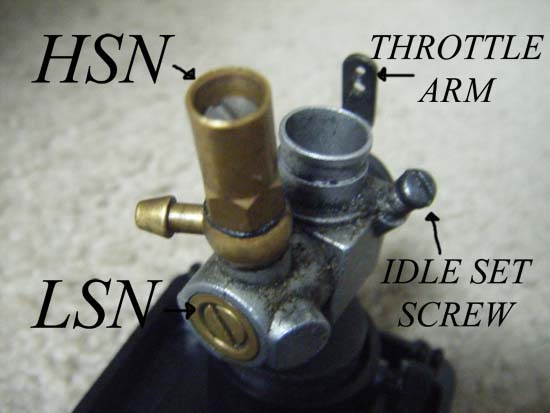
Carburetor Needles
- High-Speed Needle (HSN)
- Controls the fuel mixture at peak RPM.
- Leaning or richening the HSN affects overall engine performance.
- Incorrect HSN tuning can limit top speed or damage the engine.
- Low-Speed Needle (LSN)
- Controls fuel mixture at low RPM or slow speeds.
- Typically located 90° from the carb venturi.
Tuning Procedure
1. Start with the High-Speed Needle:
- Run the boat at full throttle.
- Listen to the engine:
- Bogging or lean sound → richen HSN
- Gurgling/rich sound → lean HSN
- Adjust small increments (max 1/8 turn per adjustment).
2. Tune the Low-Speed Needle:
- Warm up the engine and run at slowest speed.
- Listen and observe:
- Bogging/gurgling → lean LSN
- RPM rising with no throttle → richen LSN
- Acceleration test: Run at low speed, then quickly punch throttle.
- Engine quitting → adjust LSN based on noise.
- Heavy smoke on acceleration → rich; weak acceleration → lean.
Additional Notes
- Engine sound and performance are the best indicators of proper tuning.
- A nitro engine’s tune may change daily due to temperature, humidity, and pressure variations.
- Always confirm you are using the correct fuel blend for your engine.
Nitro Boat Propeller Selection
Choosing a prop for a nitro boat is simpler than for electric setups because ranges for hull types can guide your first test run. After that, performance should be fine-tuned by testing props within the recommended range.
Nitro Boat Propeller Selection Guide
Mono Hull
| Engine Size | Recommended Prop Diameter |
|---|---|
| 3.5cc | 40–45mm |
| 7.5cc | 47–57mm |
| 11cc | 56–62mm |
| 15cc | 60–65mm |
Catamaran Hull
| Engine Size | Recommended Prop Diameter |
|---|---|
| 3.5cc | 37–42mm |
| 7.5cc | 46–51mm |
| 11cc | 55–60mm |
| 15cc | 60–65mm |
Tunnel Hull
| Engine Size | Recommended Prop Diameter |
|---|---|
| 3.5cc | 37–42mm |
| 7.5cc | 46–51mm |
Sport Hydro / Outrigger
| Engine Size | Recommended Prop Diameter |
|---|---|
| 3.5cc | 45–50mm |
| 7.5cc | 47–55mm |
| 11cc | 60–67mm |
| 15cc | 67–70mm |
2-Blade vs 3-Blade Propellers
| Blade Count | Advantages |
|---|---|
| 2-Blade | Higher top speed; less engine load; higher RPM |
| 3-Blade | Faster acceleration; more thrust; increased stability; higher lift |
Quick Tips:
- Stock engines usually need larger diameter props; higher RPM mods may require smaller props.
- Test props within the recommended range to find the best performance for your hull.
- Blade count and pitch affect speed, acceleration, and handling differently for each hull type
Nitro Boat Maintenance Guide
1. Engine Maintenance
Avoid stopping the engine at Top Dead Center (TDC).
After each run, rotate the flywheel until the engine reaches the point of lowest resistance. This position ensures the piston is not sitting in the tight “pinch” area at TDC, preventing unnecessary stress on the piston and sleeve during cool-down and storage.
Prepare the engine for short-term storage (more than 5 days).
- Remove the glow plug.
- Add a few drops of after-run oil (automatic transmission fluid works as a substitute).
- Turn the engine over a few times using either the pull starter or an electric starter.
This distributes oil across internal parts and protects the engine from moisture, corrosion, and premature wear.
2. Drive Line Lubrication
Lubricate the driveline after every run, especially in high-power hulls.
- Loosen the flex coupler at the engine.
- Slide the entire flex cable assembly out through the prop shaft at the rear of the boat.
- Apply marine grease to the full length of the flex cable and the portion of the prop shaft that rides inside the stinger/strut.
- Reinstall the assembly and secure the coupler.
Proper lubrication prevents heat buildup, reduces wear, and ensures smooth power transfer.
3. Fastener Inspection
After each outing, check every fastener on the boat. Vibration from nitro engines can loosen screws and nuts quickly.
Use the correct hardware to prevent future issues:
- removable medium-strength threadlocker on suitable clean metal-to-metal threads: For screws that rarely need removal.
- Temporary/Blue Loctite: For screws threaded into metal parts that require frequent removal.
- Nylok Nuts: For hardware that must remain secure yet removable.
If you used Loctite and need to remove a fastener, apply heat to break the Loctite bond before loosening.