
If you’ve ever wondered which brushless motor performs better, this Low KV vs High KV brushless motor comparison puts the debate to rest. I tested two motors from the same series—one at 1840 KV on 8S and the other at 3650 KV on 4S—to see how they stack up both on the road and in a dyno-controlled environment.
Test Setup
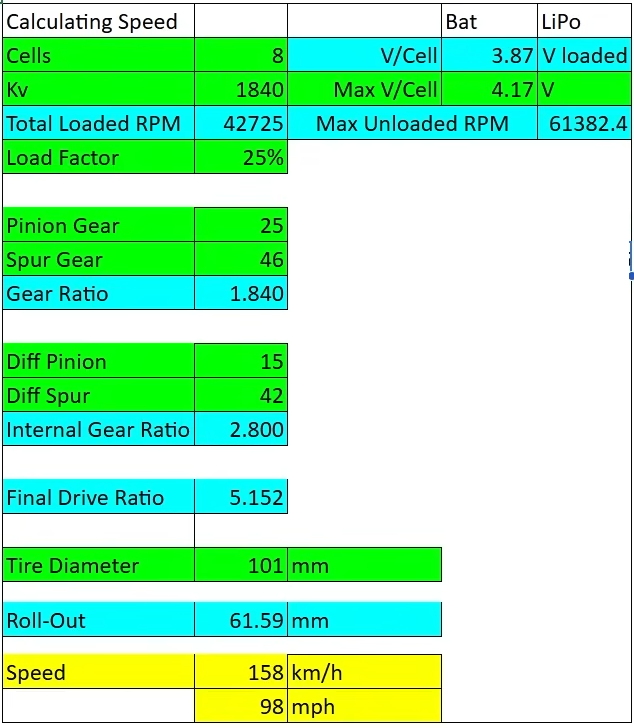
For this Low Kv vs High Kv brushless motor comparison, I calculated gearing to match each motor’s capabilities. The low Kv motor has double the windings of the high Kv motor, meaning when voltage is scaled properly, performance would be equal.
I installed both motors in the V2 Limitless. The high Kv motor used an AS150 connector for minimal voltage drop, while the low Kv motor used EC5 connectors, which caused higher losses than expected. EC5 connectors really do suck at higher current draws.
Road Test Results
| Metric | High KV Motor (3650 KV / 4S) | Low KV Motor (1840 KV / 8S) |
|---|---|---|
| Max Speed | 154 mph | 147 mph |
| Max Temperature | ~73°C | ~93°C |
| Loaded Current | ~198.8 A | ~96.6 A |
| Notes | Minimal voltage drop using AS150 connector | Voltage drop due to EC5 connectors; ran hotter due to longer full-throttle periods. Voltage drop hindered performance |
Speed differences were influenced by voltage and connector losses. Despite the low KV motor running hotter due to longer full-throttle periods, both motors delivered impressive real-world performance. Performance of these motor combinations are assumed to be equal but we can’t stop here. Let’s move on to a loaded and controlled dyno test.
Dyno Test Results
To eliminate environmental variables, I conducted a dyno test for this Low KV vs High KV brushless motor comparison:
| Metric | High KV Motor (3650 KV / 4S) | Low KV Motor (1840 KV / 8S) |
|---|---|---|
| Torque | 326 N·m | 325 N·m |
| RPM | 21,222 | 21,179 |
| Mechanical Power | 724 W | 720 W |
| Electrical Power | 976 W | 977 W |
| Efficiency | 74.2% | 73.8% |
| Notes | Pulled higher current; minimal connector losses | Slightly lower voltage due to EC5 connectors; similar performance overall |
These dyno results show that, torque output is equal for both motors as they perform identically. Efficiency differences are negligible, confirming that Kv alone doesn’t determine overall performance.
Key Takeaways
- Setup > Kv: Battery quality, ESC capacity, and connectors are more important than motor Kv and battery selection in determining performance advantages. Assuming the motor comparison is of the same diameter and length.
- Both Motors Can Win: Properly optimized, both low Kv and high Kv brushless motors achieve nearly identical results.
- Optimization is important – Connector and ESC Choice Matters: High-quality connectors and capable ESCs significantly impact speed, current, and efficiency. The low voltage, higher Kv motor setup would run on half the voltage but double the current. This means it needs a battery capacity and ESC current capacity 2X that of the low Kv, high Voltage setup.
Conclusion
This Low Kv vs High Kv brushless motor comparison proves that both motor types can deliver equally impressive performance when properly optimized. Focus on which battery you plan to use, especially if you already have plenty in that configuration. No need to go out and get others if you properly optimize your setup for the power that it needs to deliver.
Want to analyze your own setup beyond what’s covered in this post? Join RCexplained Insights Access for advanced data log analysis tools for Castle Creations ESCs, the monthly RC Calculator spreadsheet, searchable public data logs, and member resources built to help you tune, compare and improve performance. View membership plans here.