
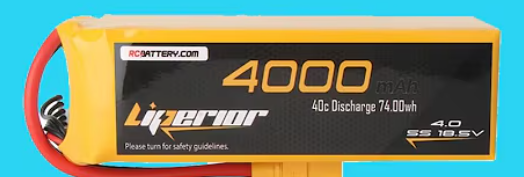
Introducing the Liperior 4000mAh 6S battery pack rated at 40C to determine its real-world performance. Using my instrumented test bench, I measured voltage, current, temperature, and milliamp-hour output to evaluate if this pack lives up to its advertised specs.
What Makes It Unique
These 40C packs are the lowest C-rated batteries I’ve tested so far, compared to previous 60C+ packs. Despite the lower rating, their slightly heavier build suggested they might deliver more punch. By testing with a controlled setup instead of just in a vehicle, I was able to capture precise data and compare it against theoretical estimates, giving a clearer picture of the battery’s actual capabilities.
Internal Resistance
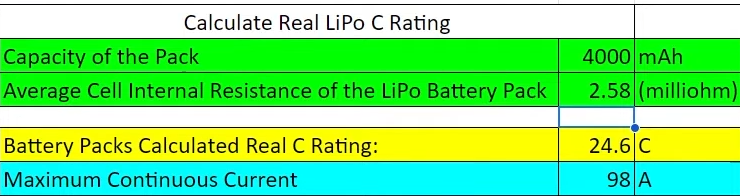
I measured internal resistance during the charge cycle. Both packs averaged 2.58 milliohms per cell, which translates to a calculated C rating of 24.6C. This is well below the advertised 40C rating. The corresponding maximum continuous current for these packs is around 98 amps. This shows that, while advertised as 40C, the real performance is closer to 25C.
Load Test
I ran a full load test on the Liperior pack. The packs delivered an average of 3420mAh, which is slightly below the advertised 4000mAh capacity. The milliamp-hour to 3.5V per cell was 1230mAh, or about 42.85% of the pack’s capacity, reached in just under 10 seconds. The pack exceeded 60°C, with temperatures varying across the battery, hotter near the wires and cooler further away. The average energy per cell was 700 Watt-minutes, and the average cell wattage was 359 watts.

Practical Applications
These Liperior 4000mAh 40C packs are suitable for applications that don’t demand maximum high-current output. They are well-suited for RC airplanes and other models where moderate power is sufficient. For most 80mm EDF setups, this pack would do quite well and are a great choice. For higher-demand EDF setups or aggressive racing applications, higher-rated packs would be a better choice.
Final Thoughts
The Liperior 4000mAh 40C pack performs better than its low rating might suggest. With a real-world C rating of around 25C, it provides reliable performance for moderate loads. While it won’t compete with higher-C-rated packs in extreme scenarios, it’s a solid choice for general-purpose use and casual RC flying.
If you’d like full access to the raw data and comparison sheets from my battery tests, consider joining my Patreon community. Becoming a member of the battery benchmark squadron gives you access to all battery tests available to date. This is in excess of 20 packs!