Today, we’re looking at the 4-channel charger vs charging LiPo batteries in parallel using a single-channel charger. We’ll compare charging speed, safety, and efficiency when charging multiple packs, so you know which setup fits your needs.
Comparing Charging Methods
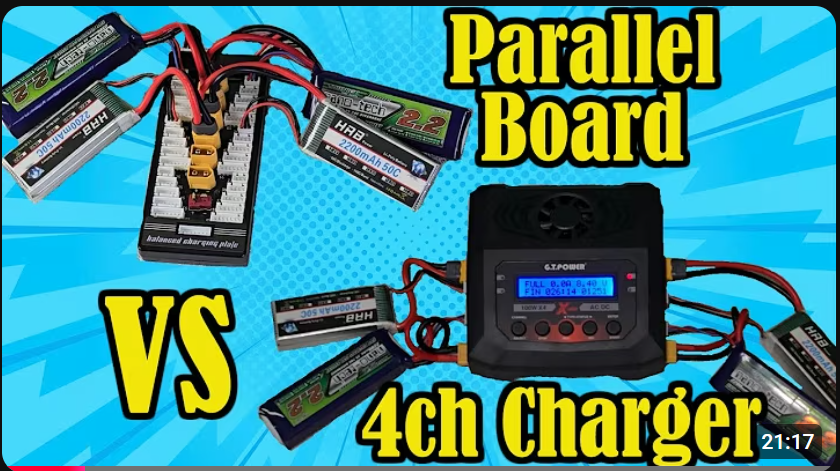
We tested charging four 2S LiPo packs in two ways: using a parallel board with a single-channel charger, and using a dedicated 4-channel charger. Parallel charging puts all packs together on one channel, while a 4-channel charger charges each pack independently.
The GT Power X4 Mini can handle four packs at 100W each, giving a total of 400W. It supports up to 4S packs and is ideal for typical 2,200 mAh batteries. In comparison, parallel charging relies on one channel and a multi-board setup, which can introduce inaccuracies in voltage and internal resistance readings.
How Multi-Channel Chargers Reduce Charge Time
When charging in parallel, the cell voltages must be closely matched to avoid imbalances. During our test, all packs were within a couple tenths of a Volt from each other. If one LiPo is at 3.70 V and the other at 4.00 V, you would need to discharge the higher-voltage pack, which averages 4.00 V per cell, down to a level closer to the lower-voltage pack. Even so, the single-channel charger experienced a long ramp-down phase. This is expected due to increased voltage drop losses in the parallel board. A higher quality parallel board would provide the best speeds. In our example, the long ramp down phase slowed overall charge time.
The 4-channel charger, on the other hand, maintained full current on each battery until 4.20V, avoiding the ramp-down problem. Individual pack voltages were measured at 4.177–4.198 V, showing tight balance and precise charging.
Optimizing for Voltage and Current
The X4 Mini allows precise control: capacity cutoff, safety timer, and internal temperature cutoff ensure safe charging. Fans kick in around 38–39°C, keeping internal temps under control. Independent charging also lets you charge different capacities and voltages simultaneously—2S, 3S, or 4S packs—without worry. You can not charge different voltages on a parallel charging board. You can charge different capacities but only if you have matching voltages per cell between each pack.
Parallel charging is fine if your packs are already matched in voltage. Charging current is shared across the packs. A calculation must be done to know your maximum safe current. I would recommend no more than 1C using the new total capacity.
Final Thoughts
If you value speed, flexibility, and precision, a 4-channel charger is the clear winner. Parallel charging works in a pinch, but only if your packs are well-matched and you’re willing to accept slower charging. For serious RC enthusiasts, investing in a 4-channel charger ensures maximum performance and safer, more efficient battery management.